Wednesday, December 18, 2013

Have Yourself a Merry Little Christmas


(Screenshot from Family Farm showing the Ornament Machine as well as the Pancake Machine)

There is a song that urges the listener to 'have yourself a Merry Little Christmas', and I always hated it for some reason.  I think it partly was because it sounded so self-indulgent, so contrary to the spirit of Christmas which is one of sharing, and partly because my Mum would quote it frequently, as she embarked upon another project of her own.   I still dislike the song, but I understand the principle better now and I myself would urge people who have no one to help with the Christmas Magic to create a little Christmas Magic for themselves.

Thank God for the internet!  Over the past two decades, in the course of writing strategy guides for games as Freyashawk, I have seen how it can transform the lives of those who for whatever reason cannot leave their homes or otherwise perform the actions that most people take for granted.  Since I became physically disabled, the internet became a lifeline of sorts, not only to allow me to shop for necessities but to distract me from severe chronic pain.

As is so often the case, it was an activity that my Mum condemned outright without knowing anything about it that was a salvation for me.  Gaming saved my sanity.  I wrote an article about it for Pain Management a number of years ago, hoping they would share it with others.  I do not think they did anything with it.  I probably should send it out myself because I believe I am uniquely qualified to write about the subject, not only as some one who is disabled, but as some one who, by virtue of writing strategy guides, came into contact with hundreds of individuals who were in a similar situation.

It is not only gaming and online gaming in particular, that offers individuals a wider canvas upon which to work, especially during the holiday season.  Applications like Facebook, for all their flaws, give people who are lonely or isolated or otherwise incapable of face-to-face social interactions, the ability to share the joys and magic of the holiday season with the world.

Virtual realities never should be mistaken for the 'bricks and mortar' reality in which we exist, but in their own way, they can be as valid as any reality in terms of alleviating depression, loneliness or pain.  'Outreach' gained a much longer reach with the internet.  For those who need the aid of 'support groups' and such, the internet offers them a way of communicating and interacting with others in like circumstances.  For those who simply love to celebrate the magic of Christmas or other holidays but cannot leave their homes, there are many venues where one can participate in the traditional Yuletide activities, from finding and trimming a tree to crafting and sharing decorations and gifts.

I personally recommend the farming simulation games as the most satisfying and least stressful for those who are looking for a virtual reality that acknowledges the Chrismtas season.  In the past four years, I have played FarmVille, Farm Town, CityVille, Lovely Farm, Fantasy Kingdoms, Castle & Co., Gourmet Ranch and Family Farm, to mention a few.  Some, like Lovely Farm and Castle & Co. no longer exist.  These games all have their own unique characters and personal preference determines how much a player enjoys a specific game as much as the actual 'playability' or long-term satisfaction that any game provides.

A friend of mine who loves food and cooking plays Gourmet Ranch religiously.  It is a quirky game that focuses on bizarre Recipes that require amazingly creative Crops and Animals as ingredients.  For me, though, it is Family Farm that dominates and offers options that are superior to any other farming simulation game. 

FarmVille once was the giant among farming simulation games but it has lost much of its following for a number of reasons.  It allowed too many external applications to load advertisements on its page and now takes an unconscionably long time to load.  Often it will crash repeatedly before it loads.  Furthermore, rather than offering one new option at a time, allowing players to explore with ease, it will bombard players with a multitude of new options.  This is counterproductive, in my view.  I continue to play FarmVille, but only in a very basic fashion.  It is exhausting and frustrating now, where once it was fun and even magical.  Furthermore, the very aggressive attempts to force players to spend significant amounts of real money on the game have become off-putting.  This all is a great pity, because I invested over three years in the game.

What does Family Farm offer that other games do not give a player?  For a start, crops NEVER wither.  That eliminates stress.  Other games attempt to force players to invest real money in farm aids that 'unwither' Crops or prevent them from withering.  In Family Farm, every Crop is protected from the moment one begins to play the game.  Another option that is lacking in many other farming simulation games is a significant 'loyalty' reward.  Where many games do not ever give the player premium cash and those who do limit the reward to 1 unit of premium cash each time a player's experience level is raised, Family Farm gives 10 units of premium cash frequently to players who have logged into the game every day.  Even before one is entitled to 10 premium cash, daily rewards will give smaller amounts until one reaches the point where 10 units are given.  I do not know of ANY other game that is as generous.

Some farming games limit energy.  I never would play those games.  FarmVille does not limit energy, nor does Family Farm.  Unfortunately, Crops will wither in FarmVille, unless one pays a fairly large sum of money for an 'Unwither Ring'.  Each Farm in FarmVille needs its own Unwither Ring to protect its Crops.  This can become exceedingly expensive.

The political campaigns that have discouraged, threatened or blackmailed society into designating the Yuletide or Christmas Season as a generic 'holiday season' has affected many online games but Family Farm is refreshingly free of such constraints.  It celebrates St. Nicholas Day and the festival of Sinterklaas.  It celebrates Christmas with unabashed enthusiasm.  That, for me, is an enormous incentive to play the game.

It is fascinating to watch the development of online games over the course of time.  Family Farm began with fairly simple Crops, Trees and Animals and simple Machines that would convert their harvests into Products that could be sold for Coins.  As it progressed, however,  the Crops, Trees and Animals became more fanciful and exotic.  The Machines underwent a transformation as well and became far more creative and interesting.  There now are machines that produce Marzipan and Christmas Ornaments and the graphics are astounding.   The Christmas Ornament machine, for example, features a Snow Globe at the top thar revolves as the Machine works to produce a variety of beautiful Ornaments.

Beyond this, another new option in the form of Crafting has been added to the game.  FarmVille has had Crafting for a long time, but the Items one makes can be used only in trade or as materials to produce other materials for projects.  In Family Farm, one can craft decorations that actually can be placed on the farm or used to Trim a Christmas Tree.  It has been a great joy to be able to craft Christmas decorations during this Yuletide season.

In FarmVille, Christmas has been masqued through the use of Animals rather than the Holy Family.  In Family Farm, this is not the case.  There are decorations that feature Angels, for example.  The graphics have an old-fashioned charm that is very refreshing in this decade.


One may play these games alone but 'groups' exist on Facebook to help fellow 'Farmers' and share ideas and responses to new options.  For the most part, social interactions are positive, even if they may lack any profound social implications.  In all honesty, though, how profound are many of our 'real' social interactions?  We all have close personal friends but in our daily lives, how often are these the people with whom we actually interact? 

Unfortunately, the internet with its instantaneous communications  in a format that usually omits the old courtesies such as greetings and farewells has influenced real-life behaviour.  Too often now, in supermarkets or on highways, people treat others with the quick dismissals and lack of common empathy that is the hallmark of internet communication.  'Friendships' are made and broken on venues such as Facebook in a second with the click of a button.   If an individual can use another Neighbour for the purpose of a game, he or she goes out to find more Friends.  When the attraction of the game pales, those 'Friends' are 'Unfriended' without any explanation being given.  If a person does not like a so-called Friend's point of view on an issue, he/she may be 'Unfriended' summarily.  I have seen it again and again.  Idealistically, one would have thought that online communications would be a means by which individuals could be educated as to the opinions and perspectives of others.  Instead, it is a place where individuals reign supreme in their own little accounts and wield the power of virtual life and death over all others, often with total abandon.  Does the fact that a person holds a political or religious opinion or belief that is opposed to one's own make that person bad or evil or even unworthy of friendship?  In the realm of Facebook or other forums, often that is all it takes to end a virtual relationship that was created with no more thought than that which officiated over its demise.   Likewise, in the realm of reality, one witnesses behaviour of people surrendering to 'road rage' or making other instant judgements that can end in violence based on nothing more than a random gesture during an encounter. 

Despite all of this, the internet offers power to the powerless and it can be positive as long as the user remembers that even virtual realities are inhabited by REAL people.  It is wonderful when a person who has lost all mobility in real life can regain it in a virtual setting, when some one who cannot leave home at all can communicate with others throughout the globe and 'travel' by virtue of shared photographs, articles and personal journals published on the internet.  It is wonderful when some one who once loved gardening but who no longer can tend to any real plot of land can plant and harvest crops and flowers and exercise creativity in landscaping in a virtual setting.  It is wonderful when our celebrations of holidays can be as extraordinary as imagination allows without reference to the limitations of money and space that reality imposes.

I therefore wish that every one should be able to 'have yourself a Merry Little Christmas' this year and may 2014 bring even greater freedom in virtual worlds to those who have lost it for whatever reason in the so-called real world.

Saturday, December 14, 2013

The Sorrows and Joys of Christmas


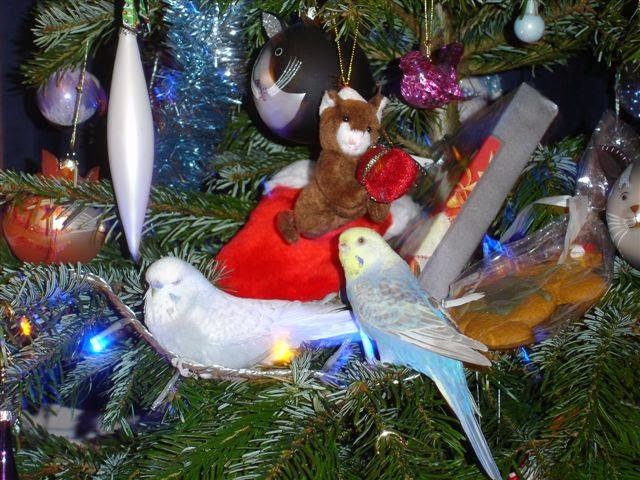
The photograph above was taken by a lady named Bev Jakins.  It is one of the most poignant and beautiful pictures of a Christmas Tree that I ever have seen.  Beautiful and amazing because these are real birds nestling in the boughs of a trimmed Tree.  Poignant because they were her beloved pets who now have departed from this world.  She gave me permission to post the photograph here.

I think now that it was after Ernst's death that I basically gave up on Christmas.  It was that and the fact that Freya had reached a stage where she no longer wished to write a note to Santa on Christmas Eve.  In other words, she was not interested in making any contribution to the magic.  My sister and I continued to write notes to Santa even after we had our own children.  It was part of our family tradition and whenever we were at home, our notes were answered.  Ritual and tradition are sacrosanct to me.  They hold things together even when the core of life falls apart.


Ernst never was anything more than a very good friend, but he probably was closer to being a soulmate in many ways than most people I have encountered.  He listened to me and ALWAYS acted as though he were interested in everything I thought or said.  I would tell him about things that I had seen, that I liked.  Whether or not he sent them was really not as important as the fact that he listened to my descriptions and engaged in my own excitement.

I lived in so many different places when I became an adult and went through so many different relationships that I never really established a proper home.  Christmas is very much a home festival.  Somehow, though, I collected a few ornaments through the years and no matter where I lived or what my financial circumstances, I tried to have a very small real tree, even if I were alone.  When Freya was born, though, Christmas changed into something quite extravagant.  Ernst and I both went a bit mad over Christmas and its rituals and decorations.  Ironic in a way that the person who shared Christmas the most with me lived hundreds of miles away and was not the father of my child.

Years passed and Ernst died.  Freya would not decorate the Tree with me and after I became disabled, it was extremely difficult to haul boxes and boxes up and down flights of spiral stairs before and after Christmas.  I suppose much of the joy had been lost as well.  Apart from that, everything reminded me too much of Ernst.   He really had been Father Christmas both for Freya and for me.  It is odd to admit that, as an adult woman, I had a genuine Father Christmas in my life but that was precisely what he was.  It was not only books and clothes and little luxuries like good soap and toiletries.  He sent the treats that one associates with the Season.  All my favourite English foods like mince pies and Devon cream, lovely preserves and Maple Sugar sweets from Maine where he lived.

As usual, I am not coming to the point directly.  With this move, I have been unable to bring much to the house but I made certain to unearth the Christmas decorations.  After over a decade, I finally opened boxes containing some of my favourite ornaments.  It is a bittersweet experience.  The wonderful friend who gave many of them to me is dead.  My daughter is at University and I essentially am experiencing the Advent Season alone.  When I tried to decorate the room with the fireplace here, my efforts were met with rather violent and bitter hostility, rather to my shock.  So there is no communion here.

I bought a little Blue Spruce Tree and placed it on the landing.  I hope that Freya will want to buy a larger tree and help me 'trim' it when she comes home, but she never has done any of the decorating, so the most I can expect is that we will go on the tree-hunting expedition together and perhaps she will bake while I decorate.    Meanwhile,  the Advent season is here.

I open the boxes that contain some of the most precious memories from my past and I cry a little but there is a part of me as well that takes joy in the beauty of these ornaments.   I know a lot of people who act as though little objects such as these are beneath them.  They like empty spaces and minimalism.  I don't.  I've lived in too many strange, empty spaces in my life.  Even when I stay in a hotel somewhere, I set out a few little personal items to make it akin to some sort of 'home'  I do not delight in sterile environments.   Clutter to me is kind of magical.  It goes back to John Cole's Book Shop and an enormous desk with drawers filled with odd little jumbled assortments of treasures.  One never knew what one would find there and the contents of any given drawer had no real theme or predictability.

My room is like that.  I don't think any one has said anything entirely positive about it actually.  Both my Mum and my daughter were rather unflattering.  Well, as far as I am concerned, it is irrelevant.  It is my only sanctuary and I will surround myself with things that have significance to me.  I'm not looking for a spread in an interior design periodical.

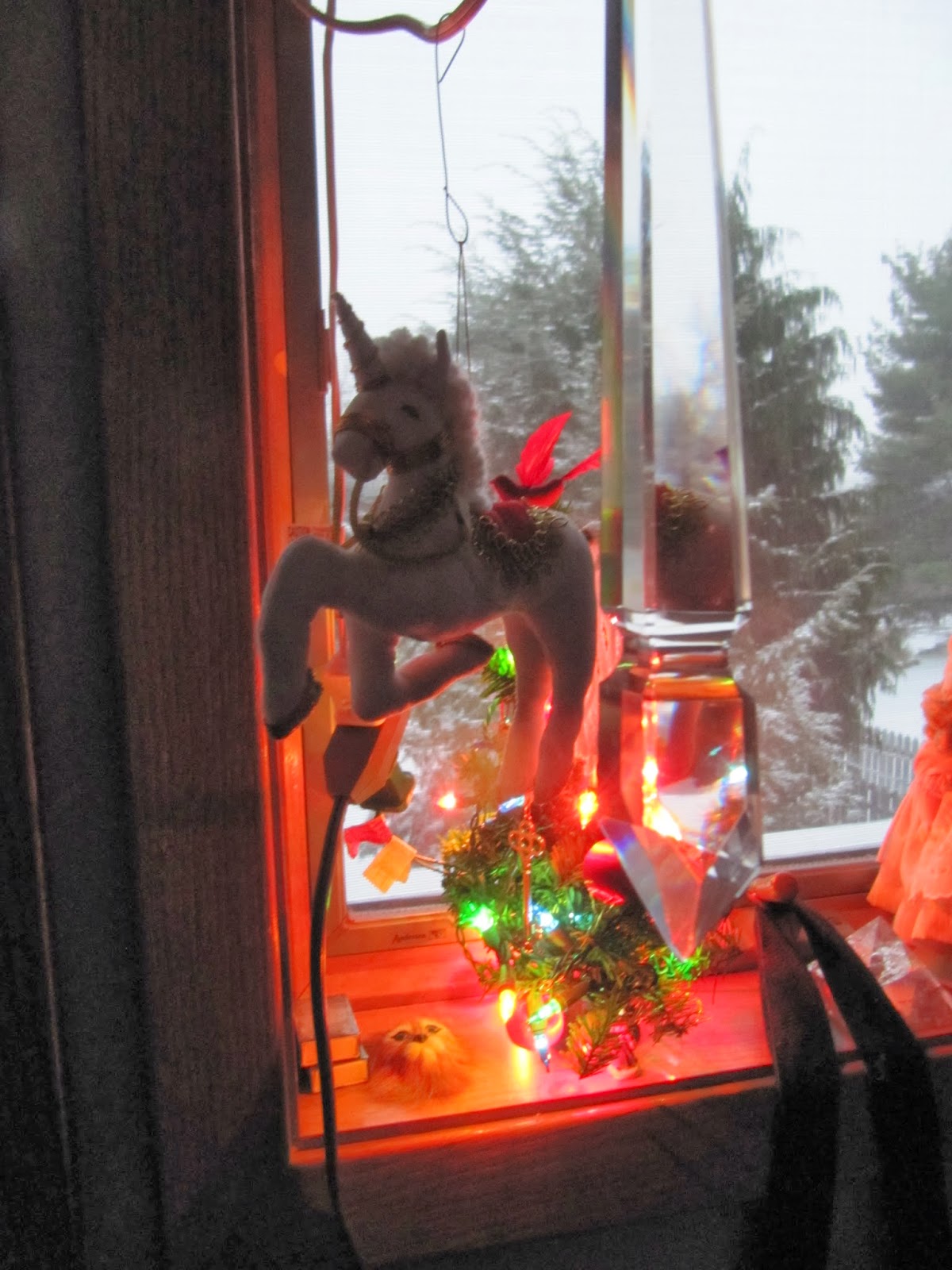
The photographs above are of two Christmas decorations that really belong on a very large, handsome Tree.  As I do not have such a Tree at the moment, I decided to hang them in my room temporarily.

The little angel doll for 'Baby's First Christmas' is very precious to me.  By the time I had Freya, I had become convinced that I never would be able to have a child.  Her first Christmas was an extraordinary event spiritually for me.  The birth of the Christ Child and the birth of my own daughter were both cause for great celebration, despite the rathe difficult circumstances of her birth.

The little white Unicorn is very special for a different reason.  It was a Christmas Gift from a guy who probably was more in tune with my own sense of magic than any one else with whom I ever had a relationship.  Sadly, he was very seriously addicted to heroin.  Despite the problems inherent in that, he made Christmas absolutely magical.  He made me the best Christmas stocking I ever had and one of the few I ever received from a guy.  I had seen the unicorn in a local shop and loved it.  We didn't have much money and I could not afford to buy it.  Looking back, I cannot imagine it cost THAT much, but I simply did not have the money for it.  He surprised me with it for Christmas.

We actually made stockings for one another.  He sewed mine and I sewed his after buying the felt and some embroidered decorations at a shop.  I have the stocking still.  I am almost absurdly sentimental.  He blessedly is NOT one of those close friends of mine who now is dead.  He no longer uses either.  I hope that he is sharing his own special sense of the Christmas Spirit with some one special in his life.

For my part, I am glad that I have so many memories and beautiful reminders of times past, even if there are some tears mingled with the joy of celebrating the birth of the Divine Child.   At Christmas Eve Mass, I always cry when the lights are dimmed, the candles lit and we sing 'Silent Night' while contemplating the creche with the Christ Child at its centre.  The carol is one that inspires intense emotion for some reason but beyond that, it always fills me with a renewed sense of the miracle of Christmas and the faith that we hold close to our hearts despite all of life's disappointments and pain.  I use the word 'Faith' in a wide sense to include the child's belief in Father Christmas as well as the visit of the Three Kings at Twelfth Night.  Faith is not the same as dogma after all.  It is that sustaining belief in Magic that defies the small-minded who claim that nothing exists beyond all that has been proved scientifically.  What difference does proof make to the landscape of the soul?   For me, Christmas is a season of great magic.  Christianity is a part of it but so are the ancient pagan traditions of the Winter Solstice.  Neither is diminished by the power of the other.  A rich inner life can accommodate both and indeed far more.


Tuesday, December 10, 2013

A Prayer for a Miracle

If God exists and if God cares about the fall of a sparrow, why not the life of a fish?  I do believe in miracles, although I realise they are few and far between and that our concept of what is best usually bears little or no resemblance to any universal reality.  After all, we may pray for a being to remain alive but if there is an afterlife, most of our myths and legends promote it as far superior to this life.  So why do we cling to this life and pray that our loved ones not die?

Oh well... I still am pleading with the Divine Being here and now for the life of little Murdoc, the dragon goldfish that Freya brought home years ago.  He has been with me longer than the Puttikins, oddly enough.  He must be nine years old at least.  I thought he was extraordinarily ugly at first with his huge 'bug eyes' or 'pop eyes'.  As I cared for him month after month, year after year, I bonded with him.  I grew to love him.  He is part of the family... and he has been dying now for three days.  I thought he had died this morning and was preparing a burial shroud when I saw a gill move.

He is on his back most of the time now.  I never knew a fish to recover from that position but... I do believe in miracles, so let's make a deal, God!  A deal that offers you absolutely nothing beyond my boundless and eternal gratitude.  I will not rage if Murdoc dies but I will weep.  I was weeping this morning, even though I do understand more than most people, as I am in pain all the time, that Death is a release from pain and misery, loss and sorrow and everything else that bedevils the human soul and body.  But please... come to my aid here, Divine Mother of All, and hear my prayer, mother to mother, and set Murdoc gently back into balance so he can continue to swim and breathe and be part of this strange little family of mine.

Murdoc died two days later.  I suppose I expected that.   Wouldn't it be lovely though if we could have some miracles from time to time?

Friday, December 6, 2013

St. Nicholas Day

Today is the 6th of December.  It is the Feast Day of St. Nicholas.  The 13th of December is the Feast Day of St. Lucy or Santa Lucia.  These feast days are a part of the Advent Calendar and somehow have become the dates when specific Christmas traditions are celebrated in certain parts of the world.  Gift-giving is very much a part of Christmas in the same way that it is integral to Ramadhan.  Charity towards the impoverished and helpless is a theme in the many myths of St. Nicholas.  The Winter Season in the Northern world always was harsh and the poor would suffer more from lack of shelter, heat and food.  It is ironic that the United States now heralds the Advent Season with a festival of Thanksgiving that is an occasion for consumers to shop until they drop.  The so-called 'Black Friday' when sales are aggressive now has been extended to embrace Thursday, the day of the Thanksgiving Feast.  Fights often break out and the queues before the sales even begin are obscene.  Are people buying gifts for others specifically or are they more concerned with 'bargain-hunting'?  I suspect the latter.  It is greed rather than charity that motivates the Black Friday events.

Whatever the ugliness that has obscured the magic of the season, I would like to share some images of St. Nicholas:


Wednesday, December 4, 2013

The Divine Right of Humanity to Rule the Earth

Once upon a time, God created the Heavens and the Earth and the Earth was without form, and Void and Darkness covered the Earth.  And God created Light for the Heavens and Earth from the  Divine Light and then created Humanity and Animals and Plants.  God then said:

'You will be my khalifs, Rulers of the Earth, to take charge of the Earth because I have bestowed upon you more power than the other creatures of this planet.  And you will assume full responsibility for the well-being and security of all living things for with the mantle of Power comes the duty to protect and care for the helpless.'

Then God commanded:  'Learn to read and write and write my message so that your descendants will understand their duties and their destiny on Earth.'

But upon the Earth there was a tribe who, having learned to read and write, came to a land of milk and honey and lusted for it.  And what they wrote was:  'And God declared:  You are my chosen people.  Take the land of milk and honey for your own and destroy its inhabitants.  Leave not one single stone standing for you are better than all the other creatures and if they are in your path, you have the right to sweep them into oblivion.'

Many thousands of years passed and the race of humans grew in arrogance and the arts of deception.  The descendants of the invaders who had translated the message of God into their own manifesto persuaded others of their special divine right and the true message of God being lost, all humanity believed in its right to use and abuse the Earth as it pleased.

God does not need to send down a Flood to cleanse the Earth of the arrogant and irresponsible.  When the people themselves destroy the fundamental integrity of the Earth, destruction will follow as surely as Night follows Day.  Poison the soil and those who consume the fruits of that soil will be poisoned.  Remove the backbone of the mountains and all that holds the waters in place and floods will follow as inevitably as Day follows Night.  We are creating our own Doom.  Why should we look to God to save us when we continue to pervert the Divine Message, continue to destroy our inheritance and refuse to perform our duties as the Rulers over all Earth's creatures and all living things?

Wednesday, November 20, 2013

Black Peter, an ancient Yuletide Tradition


black-pete-580.jpegOn Facebook, I play a game called 'Family Farm'.  A couple of days ago, a new Mission or Quest appeared in the game called 'Darryl's Pipe Dream'.  It included mentions of Black Peter and his White Horse Amerigo.

Black Peter is not a figure in our own family Yuletide traditions but I had a very good friend from Germany who remembered Black Peter and poems about him from his childhood.  He had hunted down a reproduction of a very old, formerly out-of-print book in order to renew his own acquaintance with the tradition.  He sent me a copy.  Both he and I were rather astounded by the actions of Black Peter towards the naughty boys and girls at Yuletide.  One poem involved the consumption of children's fingers!

Cannibalism is not a rare topic in folktales and fairytales.  Every one is familiar with the tale of Hansel and Gretel and the Witch who fattens them in a cage in order to make a feast of them.  Their ultimate revenge is to shut her inside her own oven.  The whole business of cannibalism is related to ancient rites of fertility, of making grand sacrifices in order to bring fertility to the soil.   'The Golden Bough' includes an entire chapter on human sacrifice.  It originally was more of a barter system that anything else.  Crops and Animals were considered to be as valuable as human beings and the sacrifice to the land of the latter was the price paid to gain a good harvest and have good hunting.

Now, I find that the figure of Black Peter is causing all sorts of absurd political controversies, much like the poor innocent Golliwogs beloved in British culture until accusations of racism made them less popular.
 
Black Peter or Zwarte Pieten is one of the many companions of St. Nicolas.  Another is Krampus.  Some believe that the companion of the Saint, whatever his name or appearance, originally was a devil or The Devil himself, chained and forced to serve as slave for the day (or period of Yuletide when St. Nicolas is actively pursuing his self-imposed duty of giving gifts and performing acts of charity and kindness).  Where Black Peter is concerned, some have postulated the old conflict between Moors and Christians as the origin and the servitude of the Moorish Black Peter as a symbol of the ultimate triumph of Christian rulers over the lands of Europe.   Others simply state that Peter is Black because he goes down chimneys and indeed, the 'black' chimneysweep is a potent symbol of good fortune throughout old Europe.  Ashes are magic and the ashes of the fire of the 'dead year' always had potency.  The chimneysweep who performed the ritual that cleaned the chimney (a potent symbol in its own right when one thinks upon the ritual of birth and emergence from the womb) was a shaman of sorts.
 
No one would suggest that Kabuki is 'racist' because the actors use 'white' paint to cover their faces and yet, 'blackface' is outlawed by stupid governments for being 'racist'.  In fact, Roman Catholics smear ashes on their foreheads on Ash Wednesday but evidently the AMOUNT of ash used or the symbol or lack thereof painted in ash is what determines whether or not such a practice is racist.  Soot IS black.  Ashes ARE black.  That is simply fact.
 
Whatever the origin, however, the fact remains that Black Peter or Krampus are very much part of traditional Yuletide celebrations and any attempt to erase them from the scene would be tantamount to erasure of part of the intrinsic culture of the land.

Here is the article about the controversy in the Netherlands:

'Each November in the Netherlands, the red-and-white-clad Sinterklaas arrives by steamboat to great fanfare. In Amsterdam alone, hundreds of thousands turn out along the canals to greet the tall, bearded saint and his helpers, jolly types called 'Zwarte Pieten' or 'Black Petes.' After riding off on a white horse, Sinterklaas is said to roam the country until December 5th, when he lands on Dutch roofs and sends his Black Petes down chimneys to deliver gifts to good little girls and boys.
The Dutch Black Petes are more fun, and thus more popular, than the staid saint they serve, and in the festive weeks before Sinterklaas returns to Spain (that’s where he lives, according to tradition) they show up everywhere, from schools to shops to company parties. The fact that they do this in blackface, with curly wigs, red lips, and gold earrings, has been a subject of controversy for decades. But this year, following a bid to include the Sinterklaas festival on a UNESCO list of the country’s 'intangible cultural heritage,' the issue has exploded in the Netherlands. One Dutch ethnologist called it 'an existential revolt not seen in Dutch society since the murder of Pim Fortuyn.'
The uproar began with an interview with Verene Shepherd, a professor of social history who, as chair of the United Nations’ Working Group of Experts on People of African Descent, received letters, spurred by the UNESCO bid, saying that the Black Pete tradition is racist. Calling the practice a throwback to slavery, she told a Dutch journalist that, 'As a black person, I feel that I, if I were living in the Netherlands, as a black person, I would object to' Black Pete, she told a Dutch journalist. Her wholly informal suggestion that Black Pete be done away with was met with pro-Black Pete protests, a stream of social-media vitriol, and a call from the far-right politician Geert Wilders to do away with the U.N.
Even the Dutch Prime Minister, Mark Rutte, weighed in, saying that 'Black Pete is black, and we can’t change that.' Two ad agency employees started a Facebook petition against 'the abolition of the Sinterklaas fest.' 'Pietitie,' a play on 'Piet' and the Dutch word for petition, got nearly two million 'likes' in two days. With posts that included a photoshopped Brad Pitt in blackface (and the question 'Brad Piet?'), Pietitiehas set records for online petitions in the country.
Two weeks ago, J. C. Kennedy, a professor of Dutch history at the University of Amsterdam, was invited to comment on the Black Pete debate on 'Newshour,' one of the most important news programs on Dutch television. 'Zwarte Piet, as experienced by the Dutch, is complex,' Kennedy explained to me. 'As I confessed on TV, I have a hard time, as an American, seeing this as an entirely innocent thing.' While the origins of Black Pete are unclear, the emergence of the figure as he is known today 'coincides with the rise of minstrel shows in the U.S. It’s a kind of black figure, not so intelligent, subservient—it’s the emergence of a stereotype of a black person or an African, the rise of the black ‘other,’ ' he said. 'But I know a lot of Dutch don’t see it that way.'
One contemporary interpretation is that the figure, now sometimes known simply as 'Pete,' is black because he climbed down the chimney (skeptics point out that Pete’s page-boy outfit remains suspiciously clean). Some have suggested painting Pete in rainbow colors, or scaling back to a simple soot-like smudge on the chin.
Peter Jan Margry, a professor of European ethnology at the University of Amsterdam, said Dutch defenders of the tradition have trouble seeing Black Pete as a racist figure because they like him so much, and have for so many generations. 'It’s in the genes of society,' he said, adding that the figure of Piet has changed over the years. 'He used to be a ‘boo-man,’ a scary person to scare children. Nowadays, he has developed into a children’s friend. The change that took place in the character of Piet didn’t take place in his appearance, which the Dutch didn’t notice has so-called racist semiotic elements, because they saw him already as a good figure.'
'From an insider point of view, this is a children’s festival and a family festival,' one that plays an important role in family togetherness, added Margry. When children outgrow Sinterklaas, the celebration involves something called 'surprises': 'a fake parcel, which often contains dirty things, that you have to go in with your fingers and find the poem written about you by a family member, which is usually sarcastic or ironic. With Sinterklaas, you can say things with a smile on your face that you are annoyed about to other family members. It’s a family festival. That’s why the Dutch are so stirred up at the idea that the U.N. might abolish this.'
'Looking from the outside, people say, ‘How is this? This isn’t possible! This is just a racist portrayal of black people,’ ' said Margry. 'Insiders say he is a nice figure for children. The two sides have such different perspectives. They don’t talk to each other, but next to each other.'
The poet and playwright Quinsy Gario, who grew up in the Netherlands and St. Maarten, echoed this. 'Both sides are not understanding where the other side is coming from,' he said. 'We’re still working on that.'
'For me, it started six or seven years ago,' said the twenty-nine-year-old of his engagement with this issue. 'One of my mom’s colleagues told her, in front of clients, ‘We were looking for our Black Pete, and there you are.’ My mom is the strongest person I know, and she called me, shaking. It’s such a micro-aggressive way of saying, ‘You aren’t one of us.’ I thought, I need to do something.'
Gario began inserting lines about chimneys and blackface into his poems at readings. He made a T-shirt that read “Black Pete is Racism” and wore it at a poetry slam, where he recited facts about Dutch colonialism, slavery, and the history of Black Pete to an unsympathetic crowd. Next, he created a performance piece in which he wore the shirt in public places. “A lot of people came up to me and started screaming,” he said. “They said, ‘What are you talking about, I’m not a racist! This is my childhood; you’re ruining my childhood!’ I would just present the facts, and they would simmer down.”
Two years ago, when Gario wore the shirt to a Sinterklaas parade in the Dutch town of Dordrecht, he was arrested by police and pepper sprayed. In August, he submitted an official complaint against this month’s Sinterklaas parade with the city of Amsterdam. 'After that, it’s been one death threat after another,' said Gario. 'One article said I was crazy. But there have also been a lot of articles finally realizing that this is racist.'
At a City of Amsterdam Complaints Commission hearing earlier this month, twenty strangers who had seen Gario’s complaint on the Internet lodged similar protests. 'They said things like, ‘Every year, I have to tell my kid he’s not a Black Pete,’ and that they hear, ‘You don’t need face paint, you’re already black,’ or ‘Your boat just arrived, shouldn’t you entertain us?’ ' he said. Amsterdam’s mayor, who urged respect and understanding but also called any disruption of a Sinterklaas parade 'clearly morally objectionable,' on par with shouting in public that Sinterklaas doesn’t exist, announced that the city would hold the event, as usual, on November 17th.
'For me, it’s not about saying this figure is racist,' said Gario. 'It’s about activating and empowering others. It’s a very interesting moment in the Netherlands, when we have to see that being Dutch doesn’t mean having white skin. It’s about being accepting of heterogeneity, because the Netherlands is black and white and Indonesian and Moroccan. It is Muslim and Christian and Buddhist and Taoist. We need to accept that to move on.'
Photograph by Michael Urban/AFP/Getty

To me, it seems truly arrogant for individuals to attempt to destroy a legitimate cultural tradition and to reinvent its interpretation by applying trendy contemporary labels such as 'racism' to it.  The fact of the matter is that

Another more frightening manifestation of the companion of St. Nicholas is the Krampus.  No one is certain of the origin of his name.  It could be a derivative of 'Grampus' or 'Kralle' (Claw) or a Bavarian word, 'Krampn', signifying  'lifeless, dried-out, gone to seed, withered'.   I personally would opt for the last one as ancient Yuletide traditions include a symbol of the dead, dethroned or otherwise discarded ruler of half of the year's calendar and the birth of the ruler of the other half.  The death of the tiny Wren at the end of the year is a tradition in the U.K. that involves one such symbol.

The Krampus usually is seen on the 5th of December, the Krampusnacht, in Alpine villages and cities.   Many residents will dress in Krampus garb, wearing thick fur and horned 'Larven', masques that feature his almost demonic countenance.  They grip tall bundles of birch branches called 'Weidenruten' to discipline those who have failed to exhibit goodness throughout the year.

Another object sometimes carried by the Krampus is the 'Butte', a child-sized tub, whispered to be used to bear off wicked children to be made into sausages.  In fact, 'Butte' is a word that denotes a sausage casing.  A less terrifying accoutrement is the Cowbell, strapped to the bodies of the Krampus actors.

Krampus Cards have become increasingly popular throughout the Alpine areas and depict adult encounters as well as the traditional assaults upon often unwary, naughty children.

The messages on these card include:

'Gruß vom Krampus!' (Greetings from the Krampus!)

'Seid ihr heuer brav gewesen? Sonst krieg ihr’s mit dem Krampusbesen!'
(Have you been good today?  If you have been naughty, you will be beaten with the Krampus Switch!'
 'Geh mach dei’ Fensterl auf, der Krampus wart’ scho‘ drauf!'
(Go open the window!  The Krampus is waiting!'
'Mit Bomben und Granaten soll dich der Teufel braten!'
(With Bombs and Grenades, the devil will fry you!)

As you can see, the Krampus often is equated with the 'Teufel' or 'Devil' and indeed, his appearance has much in common with medieval depictions of the Devil.  He appears to be part-goat with cloven hooves and horns.

On the subject of the descriptions of 'Black' and 'White' when applied to individuals, I recently saw the film, 'Thor' and was rather perturbed by the depiction of Heimdall by a Black actor.  The reason why it disturbed me was because one of Heimdall's traditional titles is 'Heimdall the White'.  The misguided desire to inject 'racial diversity' into the film included an Asian in the role  of one of the other gods of AsgardThis really does not make sense.  The culture of the Eddas is Northern and at the time when the inhabitants of the North worshipped the gods of Asgard, Asians would not have been included in their ranks.  No one expects Chinese filmmakers to use Caucasian actors in depictions of their ancestral gods or any deity associated with Buddhism for example.  Why must our own native traditions be changed or diluted by multi-national concerns?  Is it not sufficient to celebrate the traditions of ALL cultures???


Saturday, November 16, 2013

Magic Carpets and Candlelight

My maternal grandfather died when I was 10 years old and it was an extremely traumatic event, as it was my first experience of death in my own family.  My mother's reaction and grief as well as that of my grandmother and her other children that compounded the dramatic effect.  My grandfather was an artist who signed his work with the single name 'Conde'.  It was his first name rather than his last, but our family is descended from the De Conde family of France.  It therefore is very much a part of my own heritage.

Along with the blue blood of the De Conde family (albeit blood slightly tainted with insanity, it was rumoured at the Court of France), I inherited many of his interests and loves.  He had a passion for light and movement and their interaction.  He loved candles and candlelight and he loved traditional prayer rugs.  He was not Muslim and I do not know how much of the Qur'an he ever read or recited, if any, but he loved the symbolism as well as the incredible calligraphy that is associated with Islamic Art.

It was only in the past two decades that I began to believe in the concept of a permanent home for myself rather than a perpetual nomadic existence.  Having a child contributed to the change.  I then began to collect a few items with profound significance to me, even if I did not really have anywhere to place them or display them.  Among the items I collected were a few prayer rugs.

Before I became disabled, I actually used some of my prayer rugs for the traditional Muslim prayers or salat.  At the time, my daughter Freya was attending a parochial Roman Catholic school and I had many interesting dialogues with the Monsignor who was in charge of the parish.  Unlike many of his brethren, he did not see that there was anything wrong with the practice of praying Salat AND attending Mass to take Holy Communion.  We spoke of the ancient practice of the 'Hours' in Catholicism and how those prayers, set at specific times, were quite similar to Salat. 

Unfortunately, his successor was more rigid and less charitable in nature and blasted me to Hell in no uncertain terms for daring to send my daughter both to Roman Catholic Church and School and to an Islamic Madrasah and Mosque.  My poor child suffered quite a lot because of my desire to give her a wider view of the world than the narrow one afforded by parochial schools.  She thanked me later, though, for giving her the ability and freedom to choose her own faith rather than forcefeeding her any specific creed.  

In any case, it is the prayer rug and not my personal experience of crossing religious sabres with any priest that is the topic of this post.

The prayer rug probably is the origin of the legends about 'magic carpets' for it is indeed a magic carpet that acts as a ladder to heaven, allowing the worshipper the chance to gain 'nearness to God' or 'qurbatan ilallah' and possibly even a moment of true ecstacy.  There is no need for any specific design, although Islamic art does not include the depiction of the human figure but relies upon abstract designs and symbolism.  The latter can include animals as well as any scene from Nature.  It is in the art of calligraphy, though, that Islamic Art truly excels.

As a left-handed writer, I never became truly adept at many of the Western Roman alphabets when I practiced calligraphy.  Arabic, however, was a different kettle of fish, as it is written from right to left and suits a left-handed person perfectly.  There are many different styles of classical Arabic lettering.  I love the rounded forms of the Thuluth and Diwani scripts.  The intricacy of the latter, in which letters are formed within the embrace of other letters, delights and fascinates the eye and aesthetic sense of some one who essentially is of a Baroque nature.   Any one who has studied calligraphy without delving into Islamic lettering has missed a truly grand artistic tradition.

In Asia, the art of lettering was considered a form of meditation and worship, especially by Buddhists.  I always found it so, whether I wrote in Arabic, English, Latin or in Runes.  Shapes have their own power and significance irrespective of their significance in any alphabet.  A meditation upon a single letter, symbol or word can be very fruitful in artistic and spiritual terms.   For those who cannot sit still easily, the act of writing can be a method of relaxation and a conduit to the peace that may be elusive otherwise.

Prayer rugs often include calligraphy, whether it is simply the name of Allah or a verse from the Holy Qur'an.  They often contain elements of traditional symbolism such as the mihrab, a niche or keyhole that in mosques indicates the direction of qibla (the direction in which one prays).  Qibla is Mecca and worshippers at home will place their prayer rugs in the direction of Mecca as well.

When I made a study of traditional Arab embroidery, I discovered that the Palestinian thob or gown often had a mihrab on the qabbeh or 'breastplate'.  The qabbeh protects the heart and it is fitting that it should be embroidered with a mihrab, even though the powers associated with the heart in Western culture are attributed instead to the liver in Arab culture.

Apart from the mihrab, the other symbols that always appealed most to me in prayer rugs were the Lamp and the Tree of Life.  As some one who specialised in ancient Northern mythology, the Tree of Life is a central concept.  Yggdrasil in Northern lore is the Tree that connects the Nine Worlds and is the Tree upon which the All-Father Odhinn hanged himself for nine nights and days in order to gain Wisdom and the Sight.  The Tree of Life is the Ladder to Heaven in most cultures.  Shamans in the North traditionally climbed a birch tree and created a platform near the top from which to 'journey' to other realms.  The prayer rug is a less physically stressful method by which the same goal can be achieved.


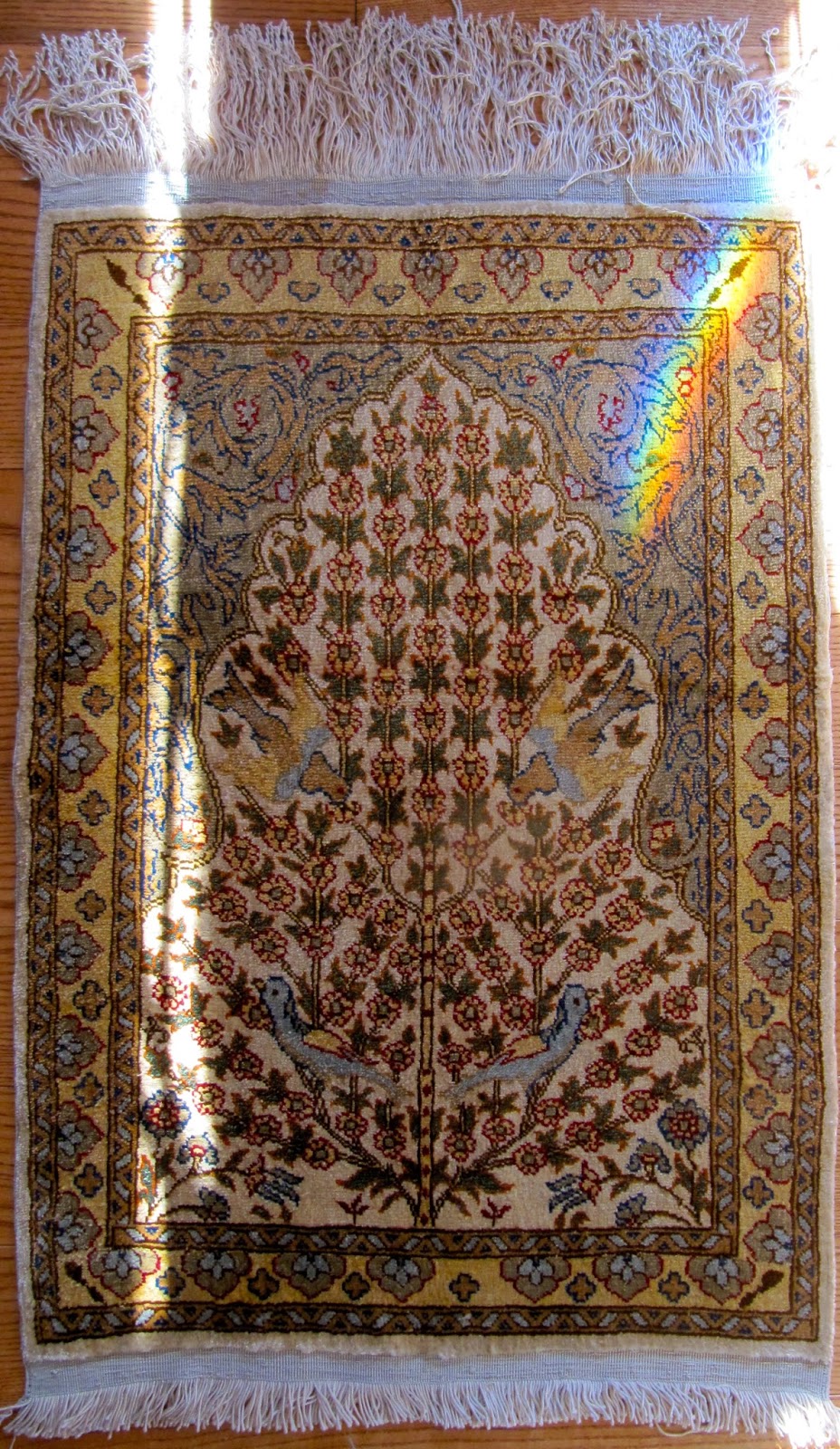
Above are some of my beautiful prayer rugs.  The one at the very bottom is the only one that actually was used as a prayer rug on the floor.  The two directly above that one are very small, woven of pure silk and designed to hang on a wall.  The one on the top is pure silk as well and is more suited to be used as a wall hanging than a rug.

The bottom rug is silk as well but was used rather extensively by its original owner as I could see the 'footprint' of both knees upon its surface where it had become rather worn through use.  It has a common design that shows the interior and exterior of a mosque on the upper half and the mihrab on the lower half.