Wednesday, March 19, 2014

Living Half a Life

My Mum and stepfather lived for over a decade between two homes in San Diego.  One was in La Jolla and the other was in La Mesa.  They stayed a few nights in La Jolla and the rest of the week in La Mesa, depending upon appointments and so on.  I never knew how stressful that could be until October when I moved from one house to another, but was not able to move most of my belongings.  Six months later, many of my belongings remain at the other house, now devoide of running water after a pipe burst during the coldest night of the year.

Without being able to drive now, I am at the mercy of other people in terms of transportation.  Nor do I have blanket permission to bring anything I like to the new house.  It is frustrating and stressful.   Furthermore, it has destroyed the Wheel of the Year to some extent in terms of being able to decorate for festivals and holidays.


I have been fascinated with festivals most of my life.  I became interested in the Eastern European Festival of Martisor before I ever had Romanian friends.  When I met a charming woman named Adryana, she was surprised by my familiarity with customs that are virtually unknown in Western Europe and the States.  She sent me a Martisor card from Romania.  I still have it, but of course, it is at the OLD house.

Martisor is celebrated on different days in different countries but sadly, is over now and I missed it, partly because of an emergency with my Puttikins and partly because of a terrible snafu with my bank that was caused by PayPal and the inability of computers to deal with real people.

More snow and ice than usual this year contributed to the problem as I was unable to go to the old house at all throughout most of the month of February.  Finally, I was able to visit yesterday and I found my beloved snowdrops in bloom and as yet, not stolen from the little garden in back of the house.  I dug up two clumps and placed them in small pots to bring them to the new house.   At that point in time, I had forgotten what day of the month it was although Martisor was on my mind because of the association of that festival with Snowdrops.

I found my Snowdrops in a local graveyard before Freya was born and through the years, they have multiplied.  They really are the first flower that appears in the cycle of the year and they are fairly hardy, blooming amidst snow and ice and continuing to bloom sometimes for a fortnight.  The snowdrops in the little pots have not bloomed fully yet, but have survived the move evidently, much to my delight.

The two people who understood my love of Martisor are dead now.  Adryana died of a sudden brain clot.  Fleming died last year after a long struggle with cancer.

Freya and I exchanged Martisors when she was a child and indeed made Martisors for one another a couple of times but she is at University now.   My enjoyment of these Festivals has diminished greatly now that I have no one with whom to share them properly.

One year, I made a traditional Martisor pair of little couple from red and white yarn.  In the years that followed, my Martisor couple were devoured gradually by moths.  The pernicious creatures worked from the back, hidden from view until it was too late.  Today, I thought I would make a new pair but discovered that although I had brought the red yarn to the new house, the white yarn remained at the old address.  Very symbolic of my life in general.

The Snowdrops in the little pots remind me somehow of the Adonis plants that the ancients grew and then threw in the river as a sacrifice.  They remind me as well of the plants that still are grown for Nawroz in Iran.  Rather than throwing them into running water, however, I think ultimately my Snowdrops need to be planted in the earth of the new house.  I will have no real spiritual roots here until some of my plants grow in this soil.

The Goddess Tree I planted at the old house died last year.  It was a sign of sorts that made it clear to me that it was time to move.  I grieve for her still.  She was not the right sort of birch but she had power.  When I placed my palms on the trunk of that tree, I could feel the thrumming of life through her veins.  It rather amazed me, in all truth.  Although I always have been interested in shamanism and magic, I never had the blind faith in any of it that so many people appear to be able to summon at will.  Magical experiences elude me for the most part, but there are moments.  One such moment occurred in the shallow caves on the French Riviera near Menton where some of the earliest human settlements have been discovered.  Such experiences are unforgettable and that is all to the good.

I am a stubborn woman and refuse to admit defeat.  If I cannot return to the old house for the white yarn, I will buy another skein and make a new couple to bring luck to this house.  Martisor is a festival that celebrates rebirth.  If one considers that our calendar does not represent an absolute, having been changed a few times through the ages, it is possible still to celebrate Martisor.

I owe it to Adryana and to Fleming both to try.


Sunday, March 9, 2014

Formulae for Folktales and Legends

Every culture has its own special formulae to begin a tale that is clearly a folktale, legend, myth or allegory.  In our own culture, it is: 'Once upon a time...'.  In the Arab Nation, the most common formula appears to be: 'In a time that is neither now nor then, in a place that is neither here nor there...'.  In other words, by making it quite clear that there is no set time in which the tale occurred and, in some cases, no set location apart from a possible mythological one, the listener or reader is alerted to the fact that the events occur in the 'Dreamtime' or Other Realm where anything is possible. 

Many myths contain kernels of real historical events and characters such as the Scandinavian myths of the Aesir and Vanir who may have been tribes in conflict initially.  Odhinn in fact may have been a warrior king who took his people to a new land and came into conflict with the native people and their gods.  Impossible to say for certain either way.  Both the Poetic Edda and the Prose Edda contain foreign elements that show the influence of Christianity.  It is a fact that the ancirent Scandinavians had both trade with the Arab Nation and served in various military groups as well as household guards for Arab leaders and governments.  It is Vikings who founded the nation later named Russia after the word for 'Red', referring to the pale-skinned, red-haired Vikings who sailed there and founded cities.

To me, the notion of ;fundamentalism' in any religion is patently absurd and whether it is the Holy Bible or the Holy Qur'an, these tales in many cases clearly were founded upon more ancient legends and myths that dealt with very different gods from Yahweh, Allah or Jehovah.  In fact, the ancient god El or Al is a newcomer when compared to Inanna.

It is odd that no one has remarked upon the beginning of Genesis and its similarity to other formulaic beginnings of legends and Creation myths.  'In the beginning God created the heavens and the earth.'
In my opinion, 'In the Beginning' is as much an alert to the fact that the tale occurs in a place that is neither here nor there and a time that is neither then nor now.

Saturday, March 8, 2014

Are you MENTAL?

I was thinking today about a short story I wrote years ago about an open ward in a Mental Hospital.  I doubt these facilities are available any longer, but at the time, I interviewed a number of patients to discover why they had committed themselves and the reasons were sometimes very surprising.

An open ward in a mental hospital could be a substitute for a holiday hotel, a cheap substitute for a 'health farm' or a refuge from an abusive spouse or lover as much as it was a place for the mentally ill or confused.  Many of the patients I interviewed were regular inmates who used the facilities for their own purposes.  They had as little in common with the 'real' inmates as with a pet goldfish.

One woman who weighed about three hundred pounds used the ward as a place to lose weight.  She would commit herself as often as her insurance would pay for the privilege.  I am not certain how much weight she ever lost but she confined herself to a liquid diet while staying at the mental institute.

Another woman was a 'suicide addict' who used the ward as a place from which to fire threats at her father, to convince him that she was tottering on the edge of the abyss.  In fact, she had a right jolly time seducing all the male nurses and aides.  Her regular attempts at suicide were coldly calculated never to cause any permanent physical damage or to place her actually at risk of meeting her maker.

A third committed herself to escape a husband who beat her regularly.  He was an alcoholic who had been in the war and suffered what now is called traumatic stress syndrome.  He should have been committed but of course had no intentions of changing any of his destructive and negative behaviour patterns.  She committed herself instead and he visited her daily, bringing gifts of flowers and books, appearing to all the world as an ideal spouse and loving companion.

There were real mental cases there as well but I could not interview them easily as most of them were rather anxious, even distraught.  There was a young man who paced up and down the corridor counting every step, back and forth, back and forth, throughout the day without any breaks in his routine.  The staff said that he did not remember even his name and that his only link with reality was his ability to count his paces.

Thursday, March 6, 2014

'Shameless' and 'Shameless': two very different shows with the same name

'Shameless' originally was a British show set on a council estate in Manchester.  It ran for many seasons and won BAFTA awards.  Like many British shows, its success appealed to entrepreneurs who decided to import it to the U.S.  Unfortunately, they created an entirely new and I feel inferior show in the process of attempting to be even more shameless than the original.

I watched a few episodes of the original British show a few years ago when it aired on BBC America.  Watching it very late at night, my concentration was haphazard and although I enjoyed it, the show did not grab me to the point where I had to watch every episode.

When the American version was released, I watched that, but have become increasingly disillusioned with a cast of characters and plots that are completely over the top and constantly seek to be more outrageous than anything in the original British series.  I found myself utterly indifferent to the characters finally as they became more caricature than believable human beings.  Despite the fact that the acting is good and there are some amusing moments, I no longer care whether or not there are any new episodes.

I then found the original British series on the internet and began to watch it.  I became completely addicted to it, despite the fact that I had to wade through multiple, identical advertisement in order to watch even one episode.  I am in the middle of the seventh season now and its allure has not decreased one iota.  I miss the characters who have gone but become involved with the new characters as they are developed.  Yes, they are 'shameless' in every sense of the word, but they all possess an essential humanity that allows the viewer to become committed to them, to care whether they live or die.

Frank Gallagher is at the very centre of the show, more anti-hero than hero but however much one may despise him at times, he does have some redeeming moments.  He is the ultimate rebel against the rules and regulations of society, quite open in his willingness to take what he can from a government and system that he believes lacks any real validity.   He stumbles through life in a constant haze of drunkenness and drug-induced euphoria, considering his children to be responsible for his welfare and well-being rather than assuming any parental duties himself.  He is utterly free and that perhaps is enviable, despite the fact that his brand of freedom is that of the vagrant who is as much at home sleeping in a ditch as he is in a bed.  He does have the various forms of government aid at his disposal which is why he is not homeless and has money for drugs and alcohol. 

'Shameless' in a sense is a manifesto of the counterculture, the same defiant revolutionary stance enshrined in the original punk rock movement in Britain where adolescents who came from the estates and who never would be able to afford gold or silver jewelry used safety pins as an alternative form of adornment.  It has a strong political message beneath the often dark comedy and the 'human interest' plots.  Like rats in a scientist's labyrinth, the inhabitants of the fictitious Chatsworth Estates find it almost impossible to escape their allotted position in society and yet, they still ive and love, in Frank's own words, 'know how to party' and generally thumb their noses at a society that considers them the useless dregs.

What happened when 'Shameless' was importated to the States?  Sadly, despite the talents of William Macy as a character actor, the series degenerated into burlesque very quickly.  The romance between Steve and Fiona in the British series was poignant.  In the States, a double identity coupled with a bizarre relationship with an illegal alien muddied the waters unnecessarily and finally capsized any interest viewers may have had in the romance. 

In the British series, Kevin and Veronica were vibrant characters whose relationship and desire for a child evoked sympathy.   In the American version, the introduction of sex between Kev and Veronica's mother in order to manufacture a baby either disgusted or left the viewer indifferent to the outcome. 

In the same way, in the States, Frank was defined more by his outrageous antics than any philosophical views or flashes of humanity.  In the British version, Frank Gallagher, despite his often vile actions, would demonstrate a quirky philosophical nature from time to time that made his ability to 'pull birds' believable.  He could quote Byron and indeed, had knowledge of Latin, however immured the gems of his knowledge were in the muck of a misspent life.  Frank Gallagher in the U.S. simply ranted and schemed, almost on autopilot.

Many British shows have been adapted or remade by American producers.  The new version can be as good as the original.  'The Office' in an example of a series that can be enjoyed both in its original version and in the American version.  The fact that Ricky Gervais was involved in both may be a factor.  The U.S. version is not simply a carbon copy of the original and indeed had a far longer run.  Through the years, the American characters developed their own unique qualitites.  Dwight Schrute has become a classic in his own right, quite independent of Gareth Keenan.   I only mention this to demonstrate that my view of the American version of 'Shameless' is not coloured by an essential prejudice against American knock-offs. 

I very much wish that the original series of 'Shameless' would be aired by one of the cable networks in the States so that people could appreciate its brilliance.  


Friday, February 14, 2014

Hearts, Flowers and Crystal or the Use of Poison in Romance


A very dear friend of mine gave me a Waterford crystal Apple early in our friendship.  Whether rock crystal or lead crystal, the prismatic properties made from these substances always delight and dazzle.
I have a Waterford votive holder with a heart motif.  I lit it today in honour of St. Valentine's Day and then thought about the use of lead, a very poisonous substance, in art.

Ancient Romans died by the thousands, thinking that they had been poisoned by their enemies when in fact it was the lead in their pipes and serving dishes that caused their deaths.  The poisonous substance makes glass far more dazzling than it otherwise would be.  Lead paint has many virtues that its less poisonous cousins lack.

One of my favourite short stories as a child was entitled Rappaccini's Daughter.  It was about a beautiful girl who had been raised in a garden of poisonous plants.  So imbued by the poisons was she that a single kiss would kill any suitor.  I am not certain why that tale appealed to me so strongly.  I certainly was fascinated with poison as a child.  I begged for a Renaissance-styled 'Poison Ring' from the local Shakespeare festival and filled it with mistletoe berries.  I wanted to have a poison garden like the one in Hawthorne's tale.

When I moved to Pennsylvania, I did have a poison garden with every poisonous plant and flower I could obtain.  Many of the most beautiful flowers and most interesting plants are poisonous actually.  Aconite and Hellebore both are gorgeous.  It is difficult sometimes to find the poisonous plants as many florists refuse to deal in them.  Poison and hallucinogenic often go hand in hand.  Lobelia and Angel's Trumpet are beautiful flowers and both cause hallucinations.


In any event, both lead crystal and poisonous flowers lead one to muse upon the correlation between beauty and danger or fatal power.   What price beauty and art?  Obviously, through the ages, mankind has been willing to risk health for the sake of art and beauty.

I personally believe that we have the right to surround ourselves with toxins if we so choose as long as they do not affect other people.  I dislike the tendency of people and governments to interfere in freedom, to make laws prohibiting certain plants or paints or crystal made with high concentrations of lead, especially in this day and age when almost EVERY ONE has access to the 'information highway'.  It is not like Ancient Rome, where the majority of the population was being poisoned without their knowledge.  If we wish to drink from leaded crystal in order to savour the beauty of the relfection of light and colour upon the faceted glass, why should we not be able to do so freely?  In any event, the concentrations of lead allowed in our own era probably are quite safe.  Knowing this, who on earth would not choose a Waterford goblet over plain glass?

Thursday, January 30, 2014

Is it Materialism or is it Repositories of Memories?


I have not had the ability to travel as I would like in recent years.  As I cannot sit for long periods of time, it is virtually impossible to take flights.  The ridiculous security measures undertaken after the events of 11 September make the business of air travel miserable in any case.  The only times I have gone anywhere, therefore, I have travelled by sea.

My memories are a little different, I suspect, from most of the tourists who took the same cruises as I.  Today, in my ongoing, lengthy war against the 'worms with wings', I decided to open the bag that contained my abayah from Tunisia.

I remember every port on that cruise vividly, even though we spent less than a day at each destination.  For me, Tunisia was Carthage, the Roman Empire and the P.L.O.  For many of the tourists, it was simply a random destination where they chose an excursion simply to be able to take photographs to show their friends.  Unfortunately, when one is scheduled to be in any port for less than 8 hours, one is very limited.  Commercial cruise excursions sometimes are the only way to see anything.

We took an excusion to the hill that was the centre of old Carthage and now has a cathedral that was trasnformed into a museum.  For me, the most memorable item there was a gorgeous, majestic Evergreen that may have sprouted from a seed descended from the ancient Trees worshipped by the followers of Attis.  In other words, the ancient ancestor of the Yuletide or Christmas Tree as well as the Cross upon which Christ was crucified.


The coach took us to the hill and then was scheduled to take us briefly into Tunis and finally to a little blue and white town called Sidi Bou Said, painted by presidential edict in the colours of blue and white and designated as a tourist spot.  I wanted to see the location of the old headquarters of the P.L.O. in Tunis but our coach driver, although admittedly fascinated by my interest, declared that it would not be possible to make the detour.  In Sidi Bou Said, while most of the tourists went off to have a carefully orchestrated guided tour of a coffee house and some souk stalls, I was determined for find an authentic abayah.

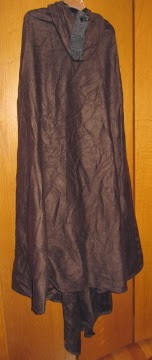
It was not easy, I have to admit.  When I asked about clothing, I was shown stuff made from synthetics, much of which actually was not even made in Tunisia.  Many of the women's clothes were made in India.  I finally found a shop where, after waiting for awhile in the front room filled with tatty souvenirs, I was shown into a dim back chamber more like a warehouse than anything else.  It was dusty and there were all sorts of shrouded rugs and items of clothing on shelves.  The owner pulled down a wrapped garment and then unfolded it, revealing a dark brown felt cloak or abaya.  He told me that it was the same kind that the president of Tunisia wore (for the sake of expressing solidarity with his people, no doubt) and furthermore, that he had only one.  The price was very high, but not as high as the hand-woven goat's wool jackets that he had and which I wished I could have bought as well.  We bargained in the time-honoured fashion over the price of tha abayah and at last, I took it away with me.  I almost missed the coach back to the ship which made my traveling companion irate... but then, he always was irate with me whenever he went on an excursion.  He did not wish to draw attention to himself or be anything other than a part of the general herd.  he hated the fact that there always was someting specific I wished to see or do and would not be a part of it in most cases.  Never mind... I found my treasure and have it still.

It is the softest, warmest garment imaginable BUT extremely impractical.  There are no openings for the arms.  The shop owner showed me how it was worn but basically it was more of a blanket than a garment in which a person could perform any sophisticated movements.  It has a faint odour of manure, shared by all of the camel hair and goat hair fabrics I have.

Back onboard ship, many of the women paraded about in very bright rayon machine-embroidered tops and skirts.  No nne had anything like my abaya or, if they did, they were not displaying theirs.  Nor was I.  I wrapped myself in it and went out on the balcony to watch the stars shimmering over the water.  

The recent move from one house to another, with most of my belongings still at the old place, has made me very aware of the sentimental nature of my life.  I never collected ANYTHING for its monetary value or its projected value in the future as a 'collectible'.  Everything I value either has some sentimental, aesthetic, emotional or magical attribute.  There is very little that I valued once upon a time that I do not value now, even if my enthusiasm may not be at the same level as it was at the time I first obtained the item.

Wednesday, January 15, 2014

The Original Thor's Hammer

We have grown so far away from our cultural roots that we often fail to see what would have been obvious to our ancestors. 


Two decades ago, before Freya was born, I planted a Birch Tree in the little garden in the centre of the city where I lived.  It was the Goddess Tree, the Tree on which the shamans of Siberia still build platforms in order to visit the other realms.  It is one of the original 'ladders to heaven'.  It never was strong enough to sustain a platform, nor steps of any kind, but it grew quite tall so that its branches reached to the second floor where there was a deck.  I decorated it with wind chimes and other offerings.  Last year, the Goddess Tree died.  It was a bad omen in a way, and it made it easier to move.

Throughout those years, the Birch showered the earth with her little seeds.  I always thought they were enchanting, and it is possible that I made the correlation with Thor's Hammer long ago and then forgot.

It was only today, when I found one on the counter of the bathroom in the new house, miles from the site of the dead Goddess Tree, that I immediately saw the shape of Thor's Hammer.  Look at the tiny seed in the centre of the photograph above.  Any one familiar with Viking talismans will see that it is precisely the shape of Thor's Hammer.  THIS is the original reason why ancients fashioned the charm from wood and metal and carried it with them.  No need to wonder why a Hammer ould have been shaped so oddly, more like a two-edged Battle Axe than any real Hammer.  It is the seed of the Birch, the Tree of Life, the Tree of Heaven for the ancient people of Northern Europe.  Even now, the White Birch is known as the 'Maiden' in some of the Northern lands.  A forest filled with those slender magical trees is utterly magical.