Wednesday, November 20, 2013

Black Peter, an ancient Yuletide Tradition


black-pete-580.jpegOn Facebook, I play a game called 'Family Farm'.  A couple of days ago, a new Mission or Quest appeared in the game called 'Darryl's Pipe Dream'.  It included mentions of Black Peter and his White Horse Amerigo.

Black Peter is not a figure in our own family Yuletide traditions but I had a very good friend from Germany who remembered Black Peter and poems about him from his childhood.  He had hunted down a reproduction of a very old, formerly out-of-print book in order to renew his own acquaintance with the tradition.  He sent me a copy.  Both he and I were rather astounded by the actions of Black Peter towards the naughty boys and girls at Yuletide.  One poem involved the consumption of children's fingers!

Cannibalism is not a rare topic in folktales and fairytales.  Every one is familiar with the tale of Hansel and Gretel and the Witch who fattens them in a cage in order to make a feast of them.  Their ultimate revenge is to shut her inside her own oven.  The whole business of cannibalism is related to ancient rites of fertility, of making grand sacrifices in order to bring fertility to the soil.   'The Golden Bough' includes an entire chapter on human sacrifice.  It originally was more of a barter system that anything else.  Crops and Animals were considered to be as valuable as human beings and the sacrifice to the land of the latter was the price paid to gain a good harvest and have good hunting.

Now, I find that the figure of Black Peter is causing all sorts of absurd political controversies, much like the poor innocent Golliwogs beloved in British culture until accusations of racism made them less popular.
 
Black Peter or Zwarte Pieten is one of the many companions of St. Nicolas.  Another is Krampus.  Some believe that the companion of the Saint, whatever his name or appearance, originally was a devil or The Devil himself, chained and forced to serve as slave for the day (or period of Yuletide when St. Nicolas is actively pursuing his self-imposed duty of giving gifts and performing acts of charity and kindness).  Where Black Peter is concerned, some have postulated the old conflict between Moors and Christians as the origin and the servitude of the Moorish Black Peter as a symbol of the ultimate triumph of Christian rulers over the lands of Europe.   Others simply state that Peter is Black because he goes down chimneys and indeed, the 'black' chimneysweep is a potent symbol of good fortune throughout old Europe.  Ashes are magic and the ashes of the fire of the 'dead year' always had potency.  The chimneysweep who performed the ritual that cleaned the chimney (a potent symbol in its own right when one thinks upon the ritual of birth and emergence from the womb) was a shaman of sorts.
 
No one would suggest that Kabuki is 'racist' because the actors use 'white' paint to cover their faces and yet, 'blackface' is outlawed by stupid governments for being 'racist'.  In fact, Roman Catholics smear ashes on their foreheads on Ash Wednesday but evidently the AMOUNT of ash used or the symbol or lack thereof painted in ash is what determines whether or not such a practice is racist.  Soot IS black.  Ashes ARE black.  That is simply fact.
 
Whatever the origin, however, the fact remains that Black Peter or Krampus are very much part of traditional Yuletide celebrations and any attempt to erase them from the scene would be tantamount to erasure of part of the intrinsic culture of the land.

Here is the article about the controversy in the Netherlands:

'Each November in the Netherlands, the red-and-white-clad Sinterklaas arrives by steamboat to great fanfare. In Amsterdam alone, hundreds of thousands turn out along the canals to greet the tall, bearded saint and his helpers, jolly types called 'Zwarte Pieten' or 'Black Petes.' After riding off on a white horse, Sinterklaas is said to roam the country until December 5th, when he lands on Dutch roofs and sends his Black Petes down chimneys to deliver gifts to good little girls and boys.
The Dutch Black Petes are more fun, and thus more popular, than the staid saint they serve, and in the festive weeks before Sinterklaas returns to Spain (that’s where he lives, according to tradition) they show up everywhere, from schools to shops to company parties. The fact that they do this in blackface, with curly wigs, red lips, and gold earrings, has been a subject of controversy for decades. But this year, following a bid to include the Sinterklaas festival on a UNESCO list of the country’s 'intangible cultural heritage,' the issue has exploded in the Netherlands. One Dutch ethnologist called it 'an existential revolt not seen in Dutch society since the murder of Pim Fortuyn.'
The uproar began with an interview with Verene Shepherd, a professor of social history who, as chair of the United Nations’ Working Group of Experts on People of African Descent, received letters, spurred by the UNESCO bid, saying that the Black Pete tradition is racist. Calling the practice a throwback to slavery, she told a Dutch journalist that, 'As a black person, I feel that I, if I were living in the Netherlands, as a black person, I would object to' Black Pete, she told a Dutch journalist. Her wholly informal suggestion that Black Pete be done away with was met with pro-Black Pete protests, a stream of social-media vitriol, and a call from the far-right politician Geert Wilders to do away with the U.N.
Even the Dutch Prime Minister, Mark Rutte, weighed in, saying that 'Black Pete is black, and we can’t change that.' Two ad agency employees started a Facebook petition against 'the abolition of the Sinterklaas fest.' 'Pietitie,' a play on 'Piet' and the Dutch word for petition, got nearly two million 'likes' in two days. With posts that included a photoshopped Brad Pitt in blackface (and the question 'Brad Piet?'), Pietitiehas set records for online petitions in the country.
Two weeks ago, J. C. Kennedy, a professor of Dutch history at the University of Amsterdam, was invited to comment on the Black Pete debate on 'Newshour,' one of the most important news programs on Dutch television. 'Zwarte Piet, as experienced by the Dutch, is complex,' Kennedy explained to me. 'As I confessed on TV, I have a hard time, as an American, seeing this as an entirely innocent thing.' While the origins of Black Pete are unclear, the emergence of the figure as he is known today 'coincides with the rise of minstrel shows in the U.S. It’s a kind of black figure, not so intelligent, subservient—it’s the emergence of a stereotype of a black person or an African, the rise of the black ‘other,’ ' he said. 'But I know a lot of Dutch don’t see it that way.'
One contemporary interpretation is that the figure, now sometimes known simply as 'Pete,' is black because he climbed down the chimney (skeptics point out that Pete’s page-boy outfit remains suspiciously clean). Some have suggested painting Pete in rainbow colors, or scaling back to a simple soot-like smudge on the chin.
Peter Jan Margry, a professor of European ethnology at the University of Amsterdam, said Dutch defenders of the tradition have trouble seeing Black Pete as a racist figure because they like him so much, and have for so many generations. 'It’s in the genes of society,' he said, adding that the figure of Piet has changed over the years. 'He used to be a ‘boo-man,’ a scary person to scare children. Nowadays, he has developed into a children’s friend. The change that took place in the character of Piet didn’t take place in his appearance, which the Dutch didn’t notice has so-called racist semiotic elements, because they saw him already as a good figure.'
'From an insider point of view, this is a children’s festival and a family festival,' one that plays an important role in family togetherness, added Margry. When children outgrow Sinterklaas, the celebration involves something called 'surprises': 'a fake parcel, which often contains dirty things, that you have to go in with your fingers and find the poem written about you by a family member, which is usually sarcastic or ironic. With Sinterklaas, you can say things with a smile on your face that you are annoyed about to other family members. It’s a family festival. That’s why the Dutch are so stirred up at the idea that the U.N. might abolish this.'
'Looking from the outside, people say, ‘How is this? This isn’t possible! This is just a racist portrayal of black people,’ ' said Margry. 'Insiders say he is a nice figure for children. The two sides have such different perspectives. They don’t talk to each other, but next to each other.'
The poet and playwright Quinsy Gario, who grew up in the Netherlands and St. Maarten, echoed this. 'Both sides are not understanding where the other side is coming from,' he said. 'We’re still working on that.'
'For me, it started six or seven years ago,' said the twenty-nine-year-old of his engagement with this issue. 'One of my mom’s colleagues told her, in front of clients, ‘We were looking for our Black Pete, and there you are.’ My mom is the strongest person I know, and she called me, shaking. It’s such a micro-aggressive way of saying, ‘You aren’t one of us.’ I thought, I need to do something.'
Gario began inserting lines about chimneys and blackface into his poems at readings. He made a T-shirt that read “Black Pete is Racism” and wore it at a poetry slam, where he recited facts about Dutch colonialism, slavery, and the history of Black Pete to an unsympathetic crowd. Next, he created a performance piece in which he wore the shirt in public places. “A lot of people came up to me and started screaming,” he said. “They said, ‘What are you talking about, I’m not a racist! This is my childhood; you’re ruining my childhood!’ I would just present the facts, and they would simmer down.”
Two years ago, when Gario wore the shirt to a Sinterklaas parade in the Dutch town of Dordrecht, he was arrested by police and pepper sprayed. In August, he submitted an official complaint against this month’s Sinterklaas parade with the city of Amsterdam. 'After that, it’s been one death threat after another,' said Gario. 'One article said I was crazy. But there have also been a lot of articles finally realizing that this is racist.'
At a City of Amsterdam Complaints Commission hearing earlier this month, twenty strangers who had seen Gario’s complaint on the Internet lodged similar protests. 'They said things like, ‘Every year, I have to tell my kid he’s not a Black Pete,’ and that they hear, ‘You don’t need face paint, you’re already black,’ or ‘Your boat just arrived, shouldn’t you entertain us?’ ' he said. Amsterdam’s mayor, who urged respect and understanding but also called any disruption of a Sinterklaas parade 'clearly morally objectionable,' on par with shouting in public that Sinterklaas doesn’t exist, announced that the city would hold the event, as usual, on November 17th.
'For me, it’s not about saying this figure is racist,' said Gario. 'It’s about activating and empowering others. It’s a very interesting moment in the Netherlands, when we have to see that being Dutch doesn’t mean having white skin. It’s about being accepting of heterogeneity, because the Netherlands is black and white and Indonesian and Moroccan. It is Muslim and Christian and Buddhist and Taoist. We need to accept that to move on.'
Photograph by Michael Urban/AFP/Getty

To me, it seems truly arrogant for individuals to attempt to destroy a legitimate cultural tradition and to reinvent its interpretation by applying trendy contemporary labels such as 'racism' to it.  The fact of the matter is that

Another more frightening manifestation of the companion of St. Nicholas is the Krampus.  No one is certain of the origin of his name.  It could be a derivative of 'Grampus' or 'Kralle' (Claw) or a Bavarian word, 'Krampn', signifying  'lifeless, dried-out, gone to seed, withered'.   I personally would opt for the last one as ancient Yuletide traditions include a symbol of the dead, dethroned or otherwise discarded ruler of half of the year's calendar and the birth of the ruler of the other half.  The death of the tiny Wren at the end of the year is a tradition in the U.K. that involves one such symbol.

The Krampus usually is seen on the 5th of December, the Krampusnacht, in Alpine villages and cities.   Many residents will dress in Krampus garb, wearing thick fur and horned 'Larven', masques that feature his almost demonic countenance.  They grip tall bundles of birch branches called 'Weidenruten' to discipline those who have failed to exhibit goodness throughout the year.

Another object sometimes carried by the Krampus is the 'Butte', a child-sized tub, whispered to be used to bear off wicked children to be made into sausages.  In fact, 'Butte' is a word that denotes a sausage casing.  A less terrifying accoutrement is the Cowbell, strapped to the bodies of the Krampus actors.

Krampus Cards have become increasingly popular throughout the Alpine areas and depict adult encounters as well as the traditional assaults upon often unwary, naughty children.

The messages on these card include:

'Gruß vom Krampus!' (Greetings from the Krampus!)

'Seid ihr heuer brav gewesen? Sonst krieg ihr’s mit dem Krampusbesen!'
(Have you been good today?  If you have been naughty, you will be beaten with the Krampus Switch!'
 'Geh mach dei’ Fensterl auf, der Krampus wart’ scho‘ drauf!'
(Go open the window!  The Krampus is waiting!'
'Mit Bomben und Granaten soll dich der Teufel braten!'
(With Bombs and Grenades, the devil will fry you!)

As you can see, the Krampus often is equated with the 'Teufel' or 'Devil' and indeed, his appearance has much in common with medieval depictions of the Devil.  He appears to be part-goat with cloven hooves and horns.

On the subject of the descriptions of 'Black' and 'White' when applied to individuals, I recently saw the film, 'Thor' and was rather perturbed by the depiction of Heimdall by a Black actor.  The reason why it disturbed me was because one of Heimdall's traditional titles is 'Heimdall the White'.  The misguided desire to inject 'racial diversity' into the film included an Asian in the role  of one of the other gods of Asgard.  This really does not make sense.  The culture of the Eddas is Northern and at the time when the inhabitants of the North worshipped the gods of Asgard, Asians would not have been included in their ranks.  No one expects Chinese filmmakers to use Caucasian actors in depictions of their ancestral gods or any deity associated with Buddhism for example.  Why must our own native traditions be changed or diluted by multi-national concerns?  Is it not sufficient to celebrate the traditions of ALL cultures???


Saturday, November 16, 2013

Magic Carpets and Candlelight

My maternal grandfather died when I was 10 years old and it was an extremely traumatic event, as it was my first experience of death in my own family.  My mother's reaction and grief as well as that of my grandmother and her other children that compounded the dramatic effect.  My grandfather was an artist who signed his work with the single name 'Conde'.  It was his first name rather than his last, but our family is descended from the De Conde family of France.  It therefore is very much a part of my own heritage.

Along with the blue blood of the De Conde family (albeit blood slightly tainted with insanity, it was rumoured at the Court of France), I inherited many of his interests and loves.  He had a passion for light and movement and their interaction.  He loved candles and candlelight and he loved traditional prayer rugs.  He was not Muslim and I do not know how much of the Qur'an he ever read or recited, if any, but he loved the symbolism as well as the incredible calligraphy that is associated with Islamic Art.

It was only in the past two decades that I began to believe in the concept of a permanent home for myself rather than a perpetual nomadic existence.  Having a child contributed to the change.  I then began to collect a few items with profound significance to me, even if I did not really have anywhere to place them or display them.  Among the items I collected were a few prayer rugs.

Before I became disabled, I actually used some of my prayer rugs for the traditional Muslim prayers or salat.  At the time, my daughter Freya was attending a parochial Roman Catholic school and I had many interesting dialogues with the Monsignor who was in charge of the parish.  Unlike many of his brethren, he did not see that there was anything wrong with the practice of praying Salat AND attending Mass to take Holy Communion.  We spoke of the ancient practice of the 'Hours' in Catholicism and how those prayers, set at specific times, were quite similar to Salat. 

Unfortunately, his successor was more rigid and less charitable in nature and blasted me to Hell in no uncertain terms for daring to send my daughter both to Roman Catholic Church and School and to an Islamic Madrasah and Mosque.  My poor child suffered quite a lot because of my desire to give her a wider view of the world than the narrow one afforded by parochial schools.  She thanked me later, though, for giving her the ability and freedom to choose her own faith rather than forcefeeding her any specific creed.  

In any case, it is the prayer rug and not my personal experience of crossing religious sabres with any priest that is the topic of this post.

The prayer rug probably is the origin of the legends about 'magic carpets' for it is indeed a magic carpet that acts as a ladder to heaven, allowing the worshipper the chance to gain 'nearness to God' or 'qurbatan ilallah' and possibly even a moment of true ecstacy.  There is no need for any specific design, although Islamic art does not include the depiction of the human figure but relies upon abstract designs and symbolism.  The latter can include animals as well as any scene from Nature.  It is in the art of calligraphy, though, that Islamic Art truly excels.

As a left-handed writer, I never became truly adept at many of the Western Roman alphabets when I practiced calligraphy.  Arabic, however, was a different kettle of fish, as it is written from right to left and suits a left-handed person perfectly.  There are many different styles of classical Arabic lettering.  I love the rounded forms of the Thuluth and Diwani scripts.  The intricacy of the latter, in which letters are formed within the embrace of other letters, delights and fascinates the eye and aesthetic sense of some one who essentially is of a Baroque nature.   Any one who has studied calligraphy without delving into Islamic lettering has missed a truly grand artistic tradition.

In Asia, the art of lettering was considered a form of meditation and worship, especially by Buddhists.  I always found it so, whether I wrote in Arabic, English, Latin or in Runes.  Shapes have their own power and significance irrespective of their significance in any alphabet.  A meditation upon a single letter, symbol or word can be very fruitful in artistic and spiritual terms.   For those who cannot sit still easily, the act of writing can be a method of relaxation and a conduit to the peace that may be elusive otherwise.

Prayer rugs often include calligraphy, whether it is simply the name of Allah or a verse from the Holy Qur'an.  They often contain elements of traditional symbolism such as the mihrab, a niche or keyhole that in mosques indicates the direction of qibla (the direction in which one prays).  Qibla is Mecca and worshippers at home will place their prayer rugs in the direction of Mecca as well.

When I made a study of traditional Arab embroidery, I discovered that the Palestinian thob or gown often had a mihrab on the qabbeh or 'breastplate'.  The qabbeh protects the heart and it is fitting that it should be embroidered with a mihrab, even though the powers associated with the heart in Western culture are attributed instead to the liver in Arab culture.

Apart from the mihrab, the other symbols that always appealed most to me in prayer rugs were the Lamp and the Tree of Life.  As some one who specialised in ancient Northern mythology, the Tree of Life is a central concept.  Yggdrasil in Northern lore is the Tree that connects the Nine Worlds and is the Tree upon which the All-Father Odhinn hanged himself for nine nights and days in order to gain Wisdom and the Sight.  The Tree of Life is the Ladder to Heaven in most cultures.  Shamans in the North traditionally climbed a birch tree and created a platform near the top from which to 'journey' to other realms.  The prayer rug is a less physically stressful method by which the same goal can be achieved.


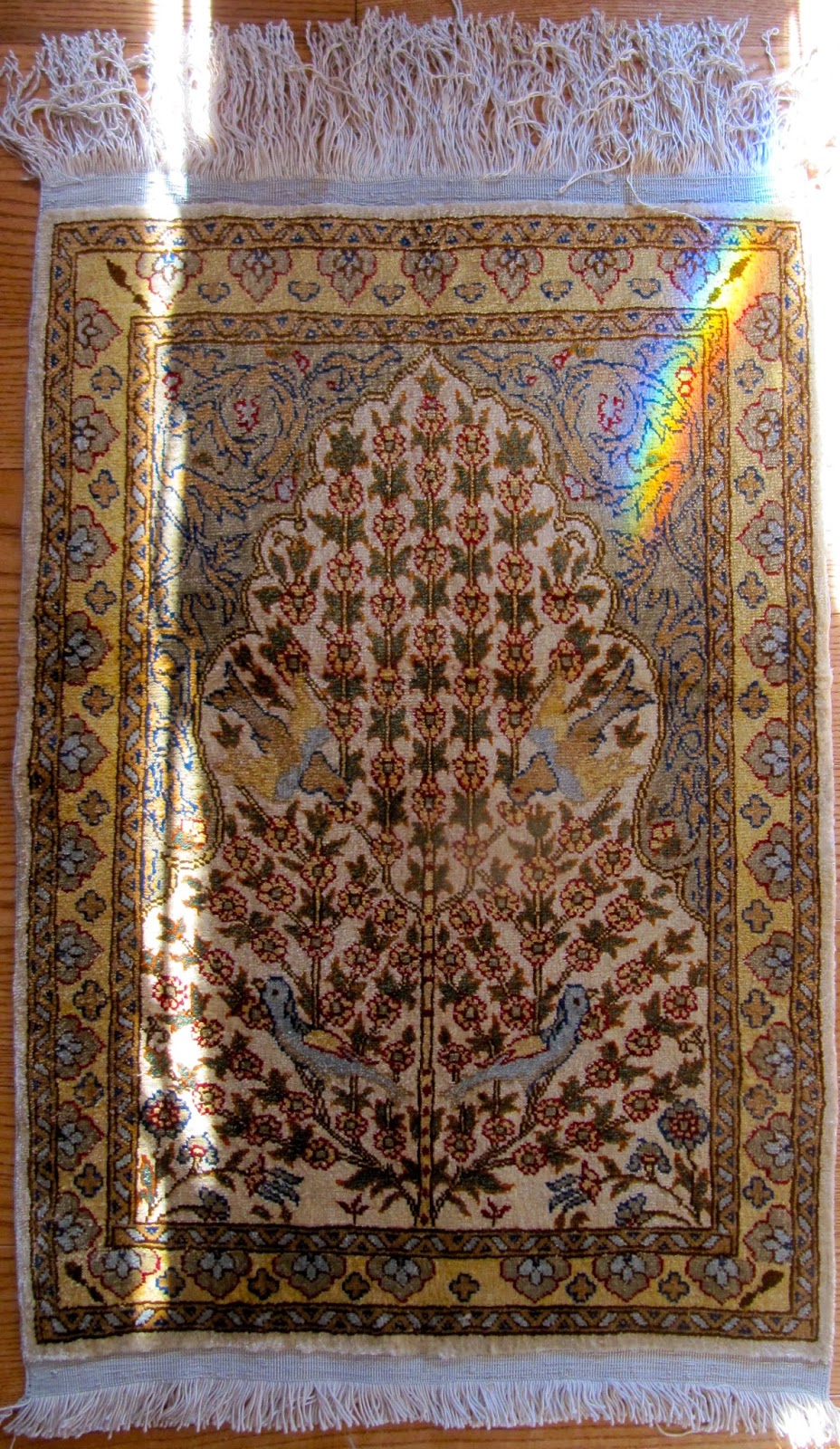
Above are some of my beautiful prayer rugs.  The one at the very bottom is the only one that actually was used as a prayer rug on the floor.  The two directly above that one are very small, woven of pure silk and designed to hang on a wall.  The one on the top is pure silk as well and is more suited to be used as a wall hanging than a rug.

The bottom rug is silk as well but was used rather extensively by its original owner as I could see the 'footprint' of both knees upon its surface where it had become rather worn through use.  It has a common design that shows the interior and exterior of a mosque on the upper half and the mihrab on the lower half.

Monday, November 4, 2013

'I am a Child of Earth and Starry Heaven... the Orphic Rites

Mircea Eliade, one of the great contemporary scholars of mystery religions, wrote about the Orphic Mysteries as well as others.  In his work, 'From Primitives to Zen', you can find some of the rites found on plates from the time before Christ:

[Plate from Petelia, South Italy, fourth-third century B.C.]

Thou shalt find to the left of the House of Hades a spring,
And by the side thereof standing a white cypress.
To this spring approach not near.
But thou shalt find another, from the Lake of Memory
Cold water flowing forth, and there are guardians before it.
Say, 'I am a child of Earth and starry Heaven;
But my race is of Heaven (alone). This ye know yourselves.
But I am parched with thirst and I perish. Give me quickly
The cold water flowing forth from the Lake of Memory.'
And of themselves they will give thee to drink of the holy spring-
And thereafter among the other heroes thou shalt have lordship.

[Plate from Eleuthernai in Crete, second century B.C.]

I am parched with thirst and I perish-Nay, drink of me (or, But give me to drink of)
The ever-flowing spring on the right, where the cypress is.
Who art thou?.....
Whence art thou?-I am the son of Earth and starry Heaven.


[Plate from Thurii, South Italy, fourth-third century B.C.]

But so soon as the spirit hath left the light of the sun,
Go to the right as far as one should go, being right wary in all things.
Hail, thou who hast suffered the suffering. This thou hadst never suffered before.
Thou art become god from man.
A kid thou art fallen into milk.
Hail, hail to thee journeying the right hand road
By holy meadows and groves of Persephone.

[Three more tablets from Thurii, of roughly the same date as the previous One. ]

I come from the pure, pure Queen of those below,
And Eukles and Eubuleus, and other Gods and Daemons.
For I also avow that I am of your blessed race.
And I have paid the- penalty for deeds unrighteous,
Whether it be that Fate laid me low or the gods immortal
Or . . . with star-flung thunderbolt.
I have flown out of the sorrowful, weary circle.
I have passed with swift feet to the diadem desired.
I have sunk beneath the bosom of the Mistress, the Queen of the
underworld.
And now I come a suppliant to holy Persephoneia,
That of her grace she send men to the seats of the Hallowed.
Happy and blessed one, thou shalt be god instead of mortal.
A kid I have fallen into milk.'

The declaration of 'I am a Child of Earth and Starry Heaven' comes to me often when I first awaken or when I step in or out of the bath.  It is very compelling for some reason.  Although some of the followers of the Orphic religion believed that the mud of the Titans (our earthly aspect) was tainted and that one should aspire to lose that in the ascension to the higher self, I find myself increasingly uhappy with that philosophy.  Perhaps Orpheus was torn to pieces by the wild beasts because they sensed his rejection of his earthly self.  We are both animal and spirit.  It is the animal in us, oddly enough, that allows us to experience the varied and marvelous experience we call 'Life'.  The spirit would be inclined to view it all as irrelevant.  If computers 'think' in a binary mode, do they translate everything into numbers in order to comprehend it?  Is that how they 'see'?  I know they are not sentient beings but even so, it strikes me as particularly sad if they must reduce everything to a binary mode in order to process it.  What we see is so much more glorious even if it is 'dross' according to the Orphic mysteries.

I neither am a mathematician, nor am I a computer programmer or even particularly adept with code.  Philip K. Dick, whom I admire tremendously, dealt with the issue of the 'thoughts' and 'souls' of machines, particularly computers.  His work, 'Do Androids Dream of Electric Sheep?' known to more people as the inspiration for the film 'Blade Runner', dealt with this topic.    The Pythagoreans and Orphic followers believed in the purity of numbers.  Numbers were divine.  If not God himself/herself, certainly they were the ladder to heaven.  The 'music of the spheres' was created from numbers.  In a sense, it is difficult to believe that they had no knowledge of 21st century technology, for much that the ancients wrote and thought is in tune with contemporary technology.

I understand how numbers can be the foundation of all things.  I understand that they are the skeleton of the items perhaps that we perceive, but it is in  the flesh and accoutrements, that beauty resides.  Does a computer, when churning out the binary formulae, perceive the beauty or is it all numbers, numbers, numbers?  That is the thought that occupies me today.

I became acquainted with code through gaming.  A game devised in the early 1990s named 'Claw' allowed players to create custom levels of their own.  It was the custom level editor that taught me that ships and sails and trees and even characters in a game are all defined by numerical code.  Change the codes and you change the essence of the thing.  Furthermore, cheat devices in games give players access to codes for unique or rare items.  If one can input the code into the game, one can acquire the rare item magically without any effort.  I basically eshew those cheat devices.  What is the point of a game if one does not PLAY it?

I am not in love with numbers but I do comprehend that numbers, as measurements, define objects.  If one makes an object too small, it can cause an entire structure to fall.  In terms of beauty, a feature that is too large or too small, out of proportion to the rest of the body, can create disharmony.  Some would disagree and declare that it is pecisely those little 'flaws' that generate true beauty.  That, however, is a matter of perception.  Where strength and practicality are concerned, precise measurements can be vital.

In the old Babylonian religion, the gods created humans from 'mud' or 'clay' to be servants as well as worshippers.  They yearned for a race of creatures who would admire and praise them.  They really probably did not NEED servants to perform tasks.  What they needed was love and adulation.  Curious, isn't it? 

How many of us can create iwthout any hope of an audience?  Most artists do not create entirely for themselves, even if the need to express themselves drives them.  They desire an audience.  They desire what the internet language terms 'feedback'.  An interesting word, that.  Feedback means to feed back to the giver or source.  In our culture, there are businesses that have become rich on nothing more than the collection of 'feedback' from consumers or 'users', whether of computer programmes or actual objects.  'Feedback' can make or destroy a firm.  Never mind whether or not it is accurate.  A certain quantity of positive or negative feedback can fuel search engines or sway corporate decision makers.


Saturday, September 7, 2013

The Fine Art of Living: Collecting or Replacing Fine China, Silver and other Antique or Vintage Items

When I was a little girl, other children my age spent their birthday and Christmas money on entertainment or clothing for the most part.  I collected China and Silver for my Hope Cheat.  I was an eccentric child prodigy and very much alienated from contemporary life in many ways.  I was placed in classes at school where all the other students were three years older than I.  I therefore was not given the freedom to pursue an ordinary social life.  Being a child among teenagers, they were able to go out on dates while I could not even visit my friends after school without parental permission and supervision.

In any case, the obsolete notion of the Hope Chest became fixed in my mind after reading a multitude of 19th century novels.  My Mother was a colletor of Chine and Silver herself.  We had afternoon tea every day on a different set of China.   We had inherited a number of different sets of 'Coronation China' from England that celebrated the coronations of various Monarchs, including one who had abdicated the throne for love.  Actually, most of that was not porcelain but rather pottery.  It was very well-suited for teatime for children and at the time was not teribly valuable, although it was fascinating stuff.  Now, many years later, some of it has increased in value.  Be that as it may, I was brought up to know Porcelain and Silver, to instantly be able to detect sterling from silverplate and to identify patterns of fine China.

I chose a very old pattern from Germany for my own Hope Chest China.  It dated from the 18th century and was made by Schumann at the time at which I began to purchase it.  The pattern was identified both as 'Empress' and 'Dresden Flowers' depending upon the date of manufacture.  I thought it was the most beautiful pattern I ever had seen.  It was very ornate, more suited for the Court of Louix XIV or even Louis XV than any other period.  Tiny hand-painted flowers were wreathed in gold and the China itself was rimmed in gold.  The actual porcelain was raised in places.  In older examples of the pattern, the plates and bowls actually were reticulated.

I went off to University later, leaving my China behind with my Mum.  I lived in a catered Hall of Residence in my first year, which meant that meals were served to us, but it was customary for students to entertain others with Coffee or Tea.  Most students purchased a jar of Instant Coffee and inexpensive Mugs.  I went to Debenhams and bought a Breakfast Set in the Royal Albert Val D'or pattern.

I loved that Set.  It was simple but elegant, fluted white with a gold rim.  I had a small teapot, coffee pot, creamer and sugar pot and service for four, with cups, saucers and little plates for sandwiches or sweets.

When, ultimately, I brought the set home with me, my Mum kept it and then added to it, thus somehow justifying her refusal to allow me to take it with me when I moved on in life.  (Did I mention that she loves China as much as I do?)

We come now to the 21st century...  There is a reason why I am writing this article.  It is not intended to be a personal memoir, however much it may appear that way.

I realised recently that if I do not begin to use the China I love at this point in time, I probably never will do so.  I therefore begged my Mum to send my Empress China.   After some resistance, she took it to a professional postal shop where they packed it and sent it to me.  In transit, the handle of the creamer broke.

Schumann no longer makes the pattern.  One therefore must resort either to a business or agency that deals in china replacements or search Ebay for the pieces one needs.  My original Empress set was purchased piece by piece from a very high-end shop in La Jolla.  There was no question as to its provenance.  There was no doubt that it was authentic and made in Germany as it had been for three hundred years.

It was only when I searched Ebay for a replacement for the broken creamer that I discovered how many manufacturers had copied the authentic pattern.


Above is a photograph of the pattern and set that I have.  It is one of the more contemporary versons of the pattern.   For those who are interested in a more in-depth history of the China and its manufacturer, there is a wonderful site:


History of Schumann China

As stated previously, however, Schumann may be the original manufacturer, but there are others who have copied the pattern.

Above is a photograph of a version of Dresden Flowers made in Japan during the Occupation.  It therefore has its own unique value but it is NOT genuine Bavarian Dresden Flowers China.  You can spot some differences easily.  The gold rim, for example, is very different from the simple line of gold on the original Schumann porcelain.  The Japanese are known for their fine porcelain and as long as the seller is honest, the buyer can make an informed choice.   In every category of antiques and 'collectibles', however, there are dishonest or ignorant sellers who attempt to pass off copies as originals.

It is not this that prompted this article, however, but an item I saw offered for sale today in the Royal Albert Lady Carlyle pattern.  It is a cake plate.  The firm that sells it honestly and openly states that the plates are made by their own 'artisans'.  Fair enough. 

Friday, June 21, 2013

Schizophrenia in the Age of Technology

Two decades ago, if I had to take a side in the eternal war between the techies and the New Age equivalent of the Luddites, I would have been hard pressed to go against one of my heroes, J.R.R. Tolkien.  HE detested technology and felt that industrialisation was the kiss of death to the imagination, the Beauty of Nature and almost everything that was magical in the world.  Apart from a lifelong long of cinema, I would have been inclined to agree...

Enter the age of the Personal Computer and a drastic shift in my lifestyle.  When Freya was four years old, we both became involved with computers.   I began to search for games for her to play as I learned how to navigate the tricky waters of the internet.  I then became involved with games myself.

When I was involved with the doll business, I became one of the earliest users of Ebay.  In those days, 'the playing field was equal' and an individual had as much power as any large business.  Later, the big businesses took over and 'Power Sellers' drove out the small individual buyer and seller.  In any case, I never was talented where money was concerned.  My gift was human relationships and ultimately, I could not value money over people.  I therefore lost money constantly as, when the doll market crashed, I allowed my customers who had made special orders that I had filled for them to bow out of their contracts.  At the same time, I basically had been coerced into accepting double shipments by big influential doll firms.  A sudden realisation by people that the concept of 'dolls for investment' had a fundamental flaw in that these items took up SPACE and had to be STORED somewhere for decades possibly before their value would increase made my former customers into rivals as they dumped their collections on Ebay.  The combination of all these factors spelt financial ruin for me.  Becoming physically disabled did not help either.  I no longer was able to ship items instantly which is what the later users of Ebay demanded.

I suppose I was naive and a Romantic in some ways.  Once upon a time, there were 'gentlamen's businesses.'  Publishing was one of these and I rather thought that doll businesses would be another.  At the beginning, that was indeed the case.  I dealt mainly with fellow doll lovers and I gave them the best prices that I could and put dolls aside for them.  They made regular small payments and were not charged anything in addition to the actual price of the doll.  

There no longer are any 'gentlemen's businesses' if there ever were.   The book publishers who attempted to run family businesses basically sold them or went bakrupt long ago.  The big manufacturers of dolls and toys are ruthless for the most part.

To me, every doll and every plush toy had a soul.  After all, books like 'Velveteen Rabbit' were an intrinsic part of my childhood psyche and the dolls I took to Nepal with me as a child were my only confidantes and the guardians of my emotional sanity during a bitterly lonely time when I lived with people who appeared to want to excise everything that meant anything to me from my life. 

I love the Animist philosophy and subscribe to it to some extent.  One of the things that drew me to Harvest Moon was the underlying Animist philosophy in those games wherein the land itself possessed a spirit and guardians in the form of the Harvest Goddess and the Harvest Sprites.  It is not only Japan either.  One of my favourite writers as a child was Ovid and I loved the 'Metamorphoses'.  In those tales, almost every flower, tree and Spring had a soul.  Perhaps people could argue that natural substances such as rocks and trees are quite different from manmade objects such as dolls, but I disagree.  I am not certain that dolls and toys possess souls from the moment that the manufacturing process is completed, unless they are handmade.   I believe rather than their owners plant the seed of a soul within them and the more time and love that is given to a doll or toy, the more that spirit or soul will grow and flourish.

In any case, what does this have to do with Luddites???  The sort of games I love are akin to my love of history, books, cinema and the objects of childhood imagination.  They create worlds wherein one can live an existence that is unencumbered by fear or strife.  On the whole, I prefer games that are set in a universe with very little technology.  The irony there, of course is that the game itself could not exist without the sophisticated technology that created the platform and all other elements apart from the concept.

When then do I play a game like Family Farm, wherein machines play an almost pivotal role?  I do not like the Machines for the most part, although whimsical contraptions such as the Carving Machine that carves pine cones and eggs into decorative objects is much more satisfying to me than the Sausage Maker.

I think that the reason I like Family Farm so much is because of the old-fashioned quality of the graphics and the characters who inhabit the game.  The Crops and Trees are very beautiful.  Some of the Animals are more attractive than others and the Animal Habitats cannot be considered Machines really.    The Kitchen, Workshop and Dessert Shop offer crafting and cooking options, so they are not really Machines either.  There is much in the game, therefore, that is not involved with Machines.

Nonetheless, if you wish to complete the various Quests, you must have all the Machines and use them regularly.  Like most of the Farming Simulation Games online, you can play the game without performing the Quests but you will progress much faster if you do complete them and you may obtain valuable rewards that otherwise might not be available.

The entire time I have been playing Family Farm, I have looked forward to the day when my level of expeirence would be high enough to 'unlock' Pink Roses as a Crop.  I finally attained that goal last night, to my delight and some surprise, as i had not been paying attention to my Experience Points at all.  On the basis of 'a watched pot never boils', I had deemed it wiser not to involve myself with XP and indeed, I believe the game made me happier when I did not pay attention to those details.

While planting my first Pink Roses and looking at all the Machines cluttering up my beautiful Farm in Family Farm, I realised how technology had induced a sort of schizophrenia in me.  I rely heavily on my laptop, on portable gaming systems and on calbe television.  Moreso now that I am disabled than I ever did when I had unfettered physical mobility. 

When I went on a cruise and was at sea for almost a month, the internet connection was so expensive and so slow that I had no ability to play any online games or even to search for information about Ports.  The most I could do was to access emails about the status of my Puttikins and to respond briefly to those.

By the time I returned, I had been 'broken' of the habit of playing the games and I actually questioned whether or not I wished to return to my virtual farming routines.

Unfortunately, there are not that many activities one can pursue in the dead of night or even during the day if pain levels are really high.  Reading or any intellectual focus is out of the question. 

I argued a case in court once about the nature of chronic severe pain and its relationship to intelligence and education levels.  There is a prejudice against individuals who are disabled but who have high intelligence and who are educated with advanced skills in any intellectual occupation.  It is thought,  erroneously that somehow intelligence, education and skills somehow will dominate the pain and transcend it.  Well, sadly, this is NOT the case. 

With respect to an uneducated individual with little education who is physically disabled, his/her inability to work or make money will be acknowledged instantly.   With respect to an educated, intelligent individual with the SAME disability or one that is even more severe, there is a presumption that somehow that individual will be clever enough to overcome the disability or thwart it in order to make money. 

INTELLIGENCE AND EDUCATION HAVE NOTHING WHATSOEVER TO DO WITH PAIN.  NOTHING.  There is no way to create an equation where Education + Intelligence > Severe Chronic Pain.  Full stop.

Again, a digression but the fact of the matter is that my natural Luddite prospensities are defeated by my love of games and the ability to access libraries on the internet without having to find transporation and overcome current pain levels.   Google has changed our lives, even though I continue to maintain that an internet search for information is only as good as the information that can be accessed on the internet.  Thanks to many tireless individuals who have spent decades uploading the texts of classics as well as out-of-print great, good and mediocre books, that pool of infomration becomes larger and larger.  Thanks to many misguided or mischievous individuals who have spent decades uploading erroneous texts and false information to the internet, one is as likely to catch a monster or mutant in the net as valid facts... so caveat emptor must apply to the student of knowledge and wisdom as much as to any individual on a shopping expedition.


Thursday, April 18, 2013

Introducing a very talented, entertaining writer

My daughter Freya is a very talented, witty girl and has embarked upon a new project for the summer.  She has created a site where she reviews live concerts.  Please do take a look at it, as her articles both amusing and informative:

Loving Live Music by Freya de Conde

Monday, April 15, 2013

3rd Anniversary of Fantasy Kingdoms and my Exploration of Facebook

Three years ago, I registered on Facebook and immediately began to explore the games.  FarmVille was recommended to me by friends who played Harvest Moon but a game I discovered by myself entitled 'Fantasy Kingdoms' won my imagination and heart as soon as I began to play it.

Fantasy Kingdoms is a rich, opulent landscape of fantasy and real crops, trees, creatures, magical 'relics' and 'artifacts', castles and other decorations.  It is truly an ideal dreamscape for any one who loves fantasy art and/or literature.  One is able to build multiple Kingdoms using the incredible objects created by the developers.  Some, like the Crops, Trees, Relics and Artifacts are interactive.  Crops are planted, grow and then can be 'frozen' or harvested upon maturity.  Trees can be harvested repeatedly.  It is the Artifacts and Relics, however, that are unique to this game and provide a truly magical experience.

Artifacts are items that must be 'Empowered' by the owner in order to be able to be transformed.  Relics, once placed, simply need to be allowed time to complete their growth.  Sometimes they are in the form of ruins that must be rebuilt through magic.  Only one act of empowerment is required for the Artifacts.  After that, time performs the magic and every Artifact and Relic has a different timeframe for its renewal. 

Like Crops, Artifacts and Relics go through various stages of growth and can be quite different visually from stage to stage.  The creators of this game are generous in their creativity which is another aspect of Fantasy Kingdoms that continues to delight and amaze.  Some games exist to make money, even if the developers have fun while they do it.  Fantasy Kingdoms appears to exist in another realm entirely, where the developers give their hearts and souls to the game in order to enrich THIS world.


Above are a few images of details from my own Fantasy Kingdoms.  One Kingdom shown here is the underwater kingdom and the other is my 'Festival Kingdom', filled with items that were created especially to mark the 1st Year Anniversary of the game.